5
Logistics locations
A warehouse and logistics market report for Teesside, with the finance we arrange across 5 logistics locations in the county.
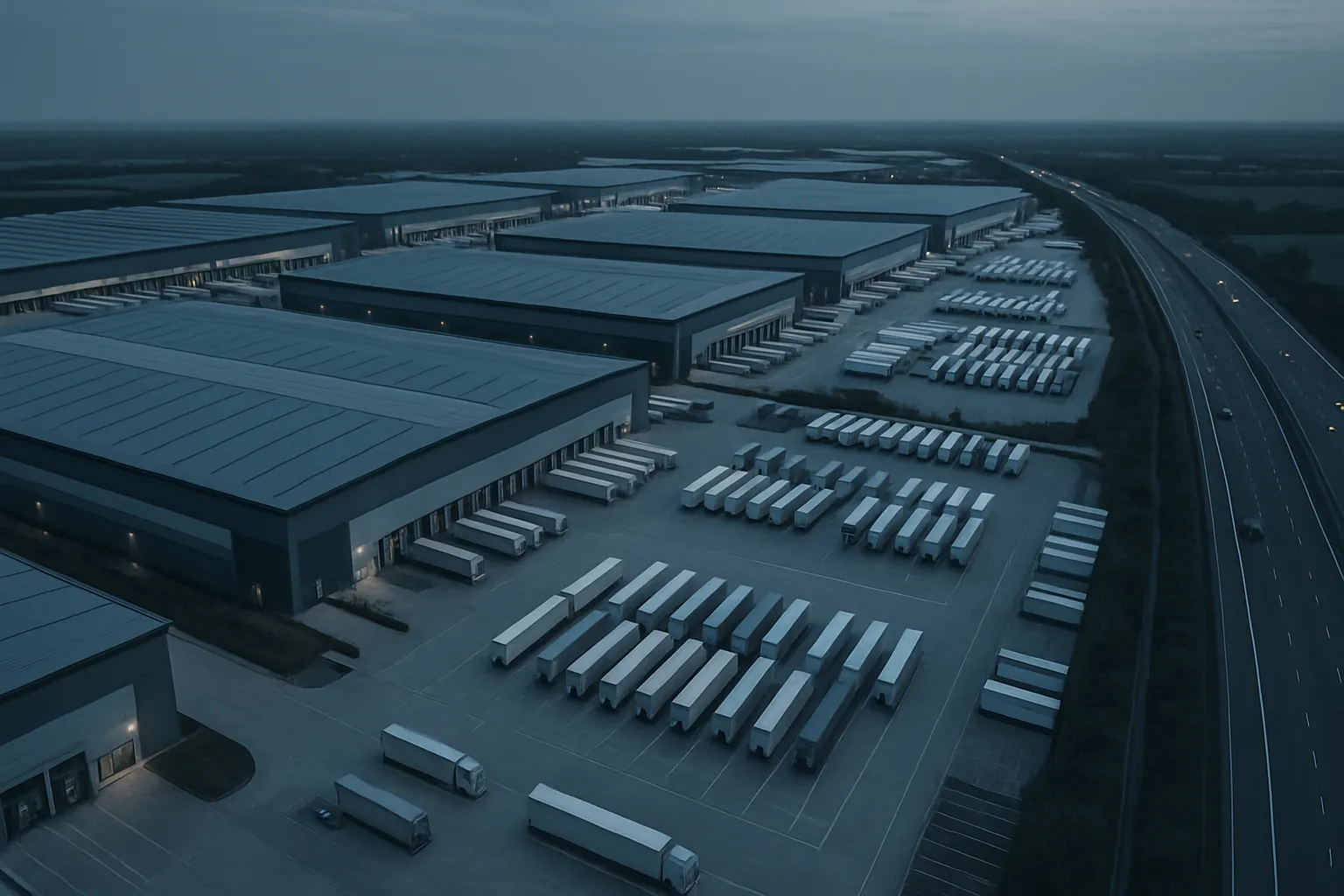
Teesside is the North East's heavy-industrial heartland, a market built on chemicals, steel, ports and, increasingly, the clean-energy transition. The defining asset is Teesworks, one of the largest industrial regeneration sites in Europe, now home to SeAH Wind's offshore wind monopile factory and sitting at the centre of the Teesside Freeport. Around it the River Tees supports a dense cluster of port and manufacturing operations, with PD Ports running the Port of Middlesbrough and the Port of Hartlepool, and the Redcar Bulk Terminal handling bulk cargoes.
The occupier base is unmistakably industrial: Fujifilm Diosynth Biotechnologies and the Billingham chemical complex, Liberty Steel's Hartlepool pipe mill, British Steel, EDF Energy, Anglo American, Cleveland Cable and AV Dawson all point to manufacturing, energy and bulk handling rather than parcel logistics. Middlesbrough and Redcar are the prime centres, with Billingham, Hartlepool and Stockton-on-Tees as established towns, and the A19, A66 and A1085 corridors tying the cluster together and out toward the A1(M).
The single most important structural feature here is the Teesside Freeport, the customs and tax framework that overlays Teesworks and surrounding sites. It is designed to attract capital-intensive manufacturing, and the SeAH Wind monopile factory at Teesworks is the flagship win, anchoring an offshore-wind supply chain on land that previously carried the legacy steelworks. This is the clearest example in the North East of heavy industrial regeneration being repurposed for the energy transition.
The implication for the property market is that Teesside's development pipeline is dominated by very large, build-to-suit industrial and manufacturing plots rather than speculative distribution sheds. Floorspace concentrates on the riverside and freeport land at Redcar, Middlesbrough and Hartlepool, and the scale of individual projects, monopile factories, biopharmaceutical plants and steel facilities, dwarfs the typical mid-box logistics deal seen elsewhere in the region.
Teesside's industrial diversity is its strength. Billingham is an established chemical and biopharmaceutical centre, home to Fujifilm Diosynth's microbial manufacturing site, while Liberty Steel's Hartlepool pipe mill makes large-diameter steel pipe for energy and infrastructure. PD Ports operates the Ports of Middlesbrough and Hartlepool, and the Redcar Bulk Terminal handles bulk trades, giving the area genuine deep-water and bulk-handling capability that few inland markets can match.
Alongside the heavy industry sits a more conventional logistics and engineering layer. Preston Farm Industrial Estate beside the A66 is a strategic engineering, manufacturing and logistics location for Stockton, and occupiers such as DHL, Howdens Joinery, Caterpillar and Country Style Foods provide distribution and general-industrial demand. This mix means the area is not a one-sector economy, which spreads occupational risk across chemicals, steel, energy, ports and logistics.
Teesside shares the North East prime metrics of roughly 8.00 to 8.50 pounds per sq ft, regional availability near 1.77m sq ft and take-up around 0.39m sq ft (Cushman and Wakefield, Q2 2025). Against the national prime big-box rent of about 11.90 pounds per sq ft, up 5.2 percent year on year (Colliers, June 2025), occupational costs are among the lowest of any major UK industrial cluster, which is precisely the draw the freeport leans on.
Much of Teesside's floorspace, however, sits outside the conventional let-investment market. Large facilities such as the SeAH monopile factory, the Fujifilm plant and the Liberty pipe mill are operational, owner-linked assets rather than tradable investment stock. The open investment market is therefore concentrated in the mid-box estates such as Preston Farm and in distribution units along the A19 and A66, where rents sit in the regional range and modern stock is limited.
North East prime industrial yields are around 5.9 percent (Cushman and Wakefield, Q2 2025), softer than the 5.00 to 5.25 percent national prime range (Knight Frank, December 2025) and the secondary level near 6 percent. Teesside's heavy-industrial character pulls in two directions. Specialist operational facilities carry strong corporate covenants but are highly bespoke, so their re-letting universe is narrow and they price more like operational real estate than generic logistics.
Standard distribution and mid-box estate stock prices closer to the regional headline, offering accessible capital values and attractive income yields relative to the South. The freeport status adds an occupier-demand tailwind that, over time, should support rents and deepen the buyer pool, but for now value remains tightly correlated to covenant quality and to how readily a given building could be re-let if vacated. That makes asset selection and tenant analysis central to pricing any Teesside deal.
We arrange and introduce industrial property debt across Teesside, and we treat the freeport and the energy-transition pipeline as central to the funding case. For investment purchases of let units, from a mid-box estate at Preston Farm to a distribution shed on the A19 or A66, we place senior loans priced off lease length and covenant; income from a strong industrial occupier supports keener terms and higher leverage, and we size debt service cover to match. Where an asset benefits from freeport tax and customs advantages, we make sure lenders understand and credit that occupier appeal.
For transitional and value-add situations we use bridging finance, for example to acquire a vacant or part-let industrial estate at Stockton or Hartlepool ahead of refurbishment and re-letting, or to bridge a riverside acquisition while leases are put in place. For ground-up schemes we arrange development funding for serviced freeport and Teesworks plots, sizing against pre-lets given the scarcity of speculative comparables and the modest prime rent, and we are comfortable with the larger lot sizes that characterise heavy-industrial development here. Once a scheme is let and stabilised, we refinance onto longer-term investment debt at valuations reflecting the 5.9 percent North East yield rather than southern pricing. Given the prevalence of specialist facilities, we focus on re-letting risk and covenant depth in selecting lenders, and we act throughout as arranger and introducer rather than as a lender.
Teesside has the clearest structural growth story in the North East. The Teesside Freeport, the Teesworks regeneration and the offshore-wind and biopharmaceutical anchors give it a demand profile tied to long-run national investment in energy and manufacturing. With national rental growth forecast at roughly 2.7 to 2.9 percent for 2026 and development completions at their lowest since 2018, modern mid-box stock should stay scarce and rents firm. The investment market will remain weighted toward covenant-led pricing, but the freeport tailwind gives Teesside a deeper demand floor than any other county in the region.
Market figures are North East-level benchmarks attributed to Cushman & Wakefield (Marketbeat Logistics & Industrial, Q2 2025), used as regional context for Teesside rather than a county-specific measurement. National figures: VOA and the research houses as cited.
Each town carries its own logistics geography and regional market context.
Five products across the whole warehouse lifecycle.
We arrange funding to acquire let warehouse and industrial investment assets across the UK.
We arrange fast, short-term bridging to secure or reposition warehouse and industrial assets.
We arrange funding for ground-up logistics and industrial schemes and major refurbishment.
We arrange funding to carry a newly completed or part-let warehouse through to full occupancy.
We arrange long-term investment mortgages on stabilised, income-producing warehouse assets.
Every sub-type is underwritten differently. We know which lenders back each one.
Send us the outline and we will come back with a view on fundability and likely terms.