10
Logistics locations
A warehouse and logistics market report for Greater London, with the finance we arrange across 10 logistics locations in the county.

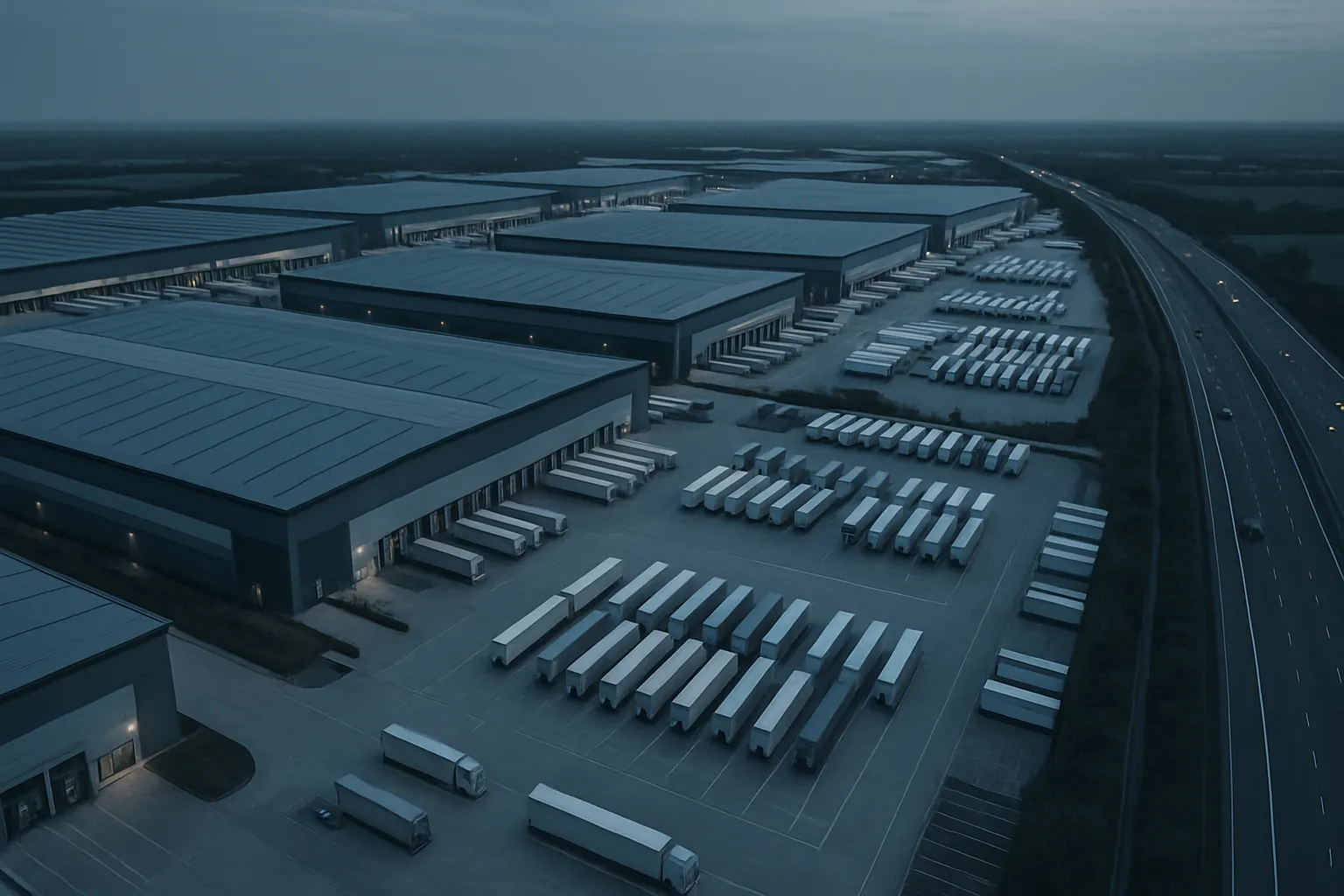
Greater London is the most expensive and most supply-constrained industrial market in the United Kingdom, and its defining feature is scarcity. Prime warehouse rents reached around £29 per sq ft in Q2 2025 (Cushman & Wakefield), well over double the national big-box benchmark of roughly £11.90 per sq ft (Colliers, June 2025), and prime yields have compressed to about 4.6 percent, the keenest in the country and inside the 5.00 to 5.25 percent range that prices stabilised stock elsewhere (Knight Frank, December 2025). London does not compete on space; it competes on proximity. Land inside the M25 that can lawfully be used for storage and distribution is finite, jealously protected and almost never replaced, which is why the capital behaves less like a regional shed market and more like a strategic asset class of its own.
The occupier base is dense and varied. Park Royal in west London, one of the largest industrial estates in Europe and the capital's primary urban logistics and food manufacturing hub, hosts a concentration of grocery, parcel and manufacturing names that few European cities can match. Across the wider market, operators including FedEx, DHL, UPS, Amazon, SEGRO, GXO and Kuehne + Nagel sit alongside food and drink producers such as Coca-Cola, Diageo, Warburtons, McVitie's, Bakkavor and Albion Fine Foods, grocers Sainsbury's, John Lewis and Booker, and specialist users from Big Yellow to the Metropolitan Police and air freight handler Air Menzies. This is a market defined by who must be here, not who would prefer to be.
Demand in London is driven by population, immediacy and the economics of the final delivery. Roughly nine million residents plus a large daytime working population create a delivery density nowhere else in the UK can replicate, and the last mile is the most expensive, time-sensitive leg of any supply chain. Parcel carriers such as FedEx, DHL and UPS, grocery and convenience operators including Sainsbury's, Booker and John Lewis, and retailers led by Amazon all need stock held close to the customer to hit same-day and next-morning service promises. A warehouse 30 miles further out is cheaper per sq ft but slower and dearer to operate once vehicle hours, congestion charges and failed-delivery costs are counted.
London is also a genuine manufacturing market, not merely a distribution one. Food and drink production anchors large parts of Park Royal and the eastern boroughs, with Coca-Cola, Diageo, Warburtons, McVitie's, Bakkavor, Mission Produce and Albion Fine Foods among the names that keep production close to the consumer for freshness, short shelf life and rapid replenishment. With manufacturing the single largest occupier type nationally in 2025 at around 33 percent of take-up (Savills), London's industrial estates are doing double duty as production sites and distribution hubs, which deepens occupier commitment and lengthens lease tenure.
Availability across the London logistics and industrial market stood at roughly 4.05m sq ft in Q2 2025 (Cushman & Wakefield), a strikingly thin figure for a market of this scale and one that sits well below the national vacancy backdrop of about 7.5 percent against a 4.6 percent ten-year average. The scarcity is partly structural and partly deliberate. Much of London's best industrial land is designated as Strategic Industrial Land, including Park Royal itself, which restricts conversion to higher-value residential or office use and is the single most important reason the capital still has an industrial base at all.
Even so, the long-run pressure runs the other way. For more than a decade industrial floorspace has been lost to housing and mixed-use redevelopment across inner and middle London, and national development completions fell to around 16m sq ft in 2025, the lowest since 2018 (Knight Frank). In a market where almost no greenfield land exists, new supply depends on replacing older single-storey sheds with denser product. The result is a chronic imbalance: when modern, well-located space is released it is absorbed quickly, and the gap between what occupiers want and what exists keeps upward pressure on rents.
Because flat land is exhausted, London is the UK's proving ground for industrial intensification and multi-storey logistics. Developers increasingly build up rather than out, stacking warehouse floors with ramped vehicle access to extract more lettable area from the same footprint, and SEGRO has led much of this thinking across its London portfolio. SEGRO Park Tottenham is a net zero logistics and industrial scheme in a sought-after north London last-mile location, SEGRO Park Greenford Central is an established west London distribution estate adjacent to the A40 Western Avenue, and the London Sustainable Industries Park at Dagenham Dock is a major SEGRO-backed logistics and light industrial regeneration site in the east.
Activity clusters around the arterial corridors and the airport. The North Circular A406, the A40, the A13, the A10 and the A312 frame the principal industrial belts, and the prime towns of Barking, Dagenham, Hayes and Park Royal anchor demand alongside established centres at Croydon, Enfield, Feltham, Greenford, Tottenham and Wembley. The Heathrow cluster is a market in its own right: Polar Park in Hayes sits on the airport boundary serving air freight, and the North Feltham Trading Estate sits close to the cargo terminal handling air freight and last-mile work. Brimsdown in Enfield ranks as the second largest industrial area in London after Park Royal, while the Purley Way and Beddington Lane corridors form Croydon's principal last-mile areas with direct A23 access.
London industrial assets price on land value and rental-growth expectation rather than building specification alone, which is why the capital's yields are sharper than anywhere in the UK. A prime yield near 4.6 percent reflects investor conviction that London rents, already the highest in the country, have further to run as supply tightens and the alternative-use value of the land underpins the downside. Even secondary and older single-storey stock, which would trade around a 6 percent yield in most regions, commands keener pricing in London because of redevelopment optionality and the near-impossibility of replacing it.
For lenders and investors this changes the calculus. The risk is rarely whether a well-located London estate can be let; it is the entry price, the strength of the reversion and, on redevelopment plays, the planning and intensification angle. Strategic Industrial Land protection cuts both ways: it supports income durability by limiting competing supply, but it also constrains the change-of-use exits that some investors might otherwise underwrite. Assets backed by long leases to grocery, parcel and food-manufacturing covenants of the kind found across Park Royal and the eastern boroughs are among the most defensive industrial holdings in the country.
We arrange warehouse and industrial property finance across Greater London for purchase, bridging, development, intensification, stabilisation and term debt, working as an introducer and arranger rather than a lender. Because London prices on land value and rental reversion as much as on bricks, we structure facilities around the angle that matters for each asset: senior investment loans against income-producing estates in Park Royal, Brimsdown, the Heathrow cluster or the eastern boroughs; bridging finance to secure stock quickly where the best space is absorbed fast; and development or refurbishment funding for the multi-storey and net zero schemes SEGRO has pioneered at Tottenham, Greenford and Dagenham Dock.
We place purchase and term debt against let assets carrying grocery, parcel and food-manufacturing covenants, and we arrange stabilisation finance to move completed schemes onto longer-term facilities once income is proven. For investors underwriting redevelopment and intensification, we structure funding that recognises both the income from the existing use and the optionality created by London's acute land scarcity. Across the corridors of the A406, A40, A13, A10 and A312 and the prime markets of Barking, Dagenham, Hayes and Park Royal, we connect borrowers with lenders who treat London industrial as the distinct asset class it is.
The outlook for London industrial is one of continued scarcity-led strength. With availability near 4.05m sq ft, national completions at their lowest since 2018 and Strategic Industrial Land protection limiting the erosion of supply, the imbalance that has driven rents to around £29 per sq ft shows little sign of easing, and the national rental-growth forecast of roughly 2.7 to 2.9 percent for 2026 is likely to be exceeded in the best London last-mile locations. The structural shift toward multi-storey and intensified schemes around the corridors and Heathrow will define new supply, and prime yields near 4.6 percent should remain the keenest in the UK while demand from parcel, grocery and food-manufacturing occupiers holds firm.
Market figures are Greater London-level benchmarks attributed to Cushman & Wakefield (Marketbeat Logistics & Industrial, Q2 2025), used as regional context for Greater London rather than a county-specific measurement. National figures: VOA and the research houses as cited.
Each town carries its own logistics geography and regional market context.
Five products across the whole warehouse lifecycle.
We arrange funding to acquire let warehouse and industrial investment assets across the UK.
We arrange fast, short-term bridging to secure or reposition warehouse and industrial assets.
We arrange funding for ground-up logistics and industrial schemes and major refurbishment.
We arrange funding to carry a newly completed or part-let warehouse through to full occupancy.
We arrange long-term investment mortgages on stabilised, income-producing warehouse assets.
Every sub-type is underwritten differently. We know which lenders back each one.
Send us the outline and we will come back with a view on fundability and likely terms.