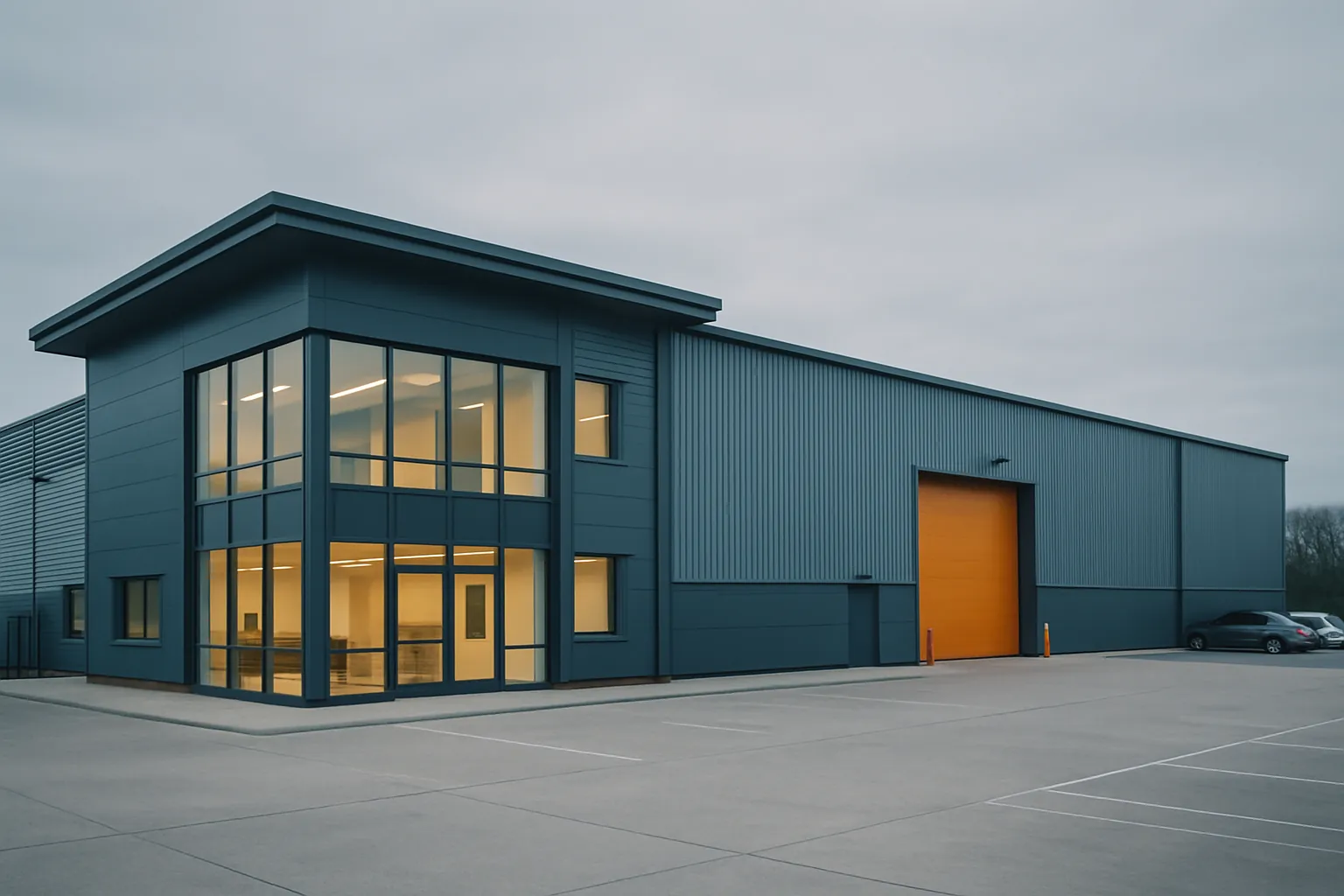
Manufacturing and light industrial finance
Funding for production and workshop units with some office content, often bought and held by the businesses that occupy them.

Funding manufacturing and light industrial
A manufacturing or light industrial unit is an industrial unit that combines production or assembly space with a measure of office and welfare accommodation. These range from single workshops to larger production facilities, and owner-occupation is common, with the business that uses the building also owning it as a long-term asset.
Specification varies with the process inside, from straightforward assembly to power-hungry production lines, so buildings are often fitted to the occupier. Demand from manufacturers is strong, and manufacturing was the largest occupier type in the market in 2025, which underpins both rents and owner-occupier values, as well as the loan to value (LTV) lenders will set on a commercial mortgage for this class.
What we fund
- Production and assembly units with office and welfare space
- Single workshops through to larger production facilities
- Owner-occupied premises held by the trading business
- Process-specific power, floor loading and ventilation
- Light industrial parks mixing manufacturing and trade occupiers
Indicative terms
- Typical lot size£1m to £30m
- Purchase LTVUp to ~70%
- Development LTCUp to ~65%
- Typical lease / incomeOwner-occupier or 5 to 15 year leases
Indicative only. Terms vary by lender, asset and borrower and are not an offer of finance.
Owner-occupier commercial mortgages for industrial units
We arrange an owner-occupier commercial mortgage for businesses buying the premises they trade from, alongside investment finance for landlords holding let industrial units. For expansion and new build we source development finance against cost and end value, and where a business needs to move quickly to secure a site we arrange bridging ahead of longer term debt. Once the building is in use or let, we put a term commercial mortgage in place, often structured to suit the trading business behind the premises. We act as arranger and introducer, not as a lender.
How lenders assess owner-occupier industrial deals
Both property lenders and trading-business lenders are active here, since many deals are owner-occupier purchases. For let stock, underwriting looks at the lease, covenant and the residual flexibility of the building. For owner-occupiers, lenders also assess the trading performance of the business and its ability to service debt, taking a view on how readily a process-specific industrial unit could be relet if the occupier left, which can shape the loan to value.
The manufacturing and light industrial market
Manufacturing was the largest occupier type in 2025 at around 33 percent of take-up according to Savills, ahead of third-party logistics operators at around 31.5 percent per Savills, which reflects steady underlying demand for production space. Prime mid-box and multi-let rent, the closest published benchmark to smaller industrial units, reached £15.55 per sq ft in June 2025, up 4.0 percent year on year per Colliers. Overall take-up ran at around 40.8m sq ft on a 50,000 sq ft and above basis per Knight Frank, with completions at around 16m sq ft in 2025, the lowest since 2018 per Knight Frank, keeping supply tight.
Finance that suits this asset class
- Purchase and investment financeOwner-occupier and investment purchases of industrial units.
- Development financeExpansion and new-build production facilities.
- Bridging financeMoving quickly to secure a site before term debt.
- Term loansLonger hold debt structured around the trading business.
Useful calculators
Related guides
Fund a manufacturing and light industrial deal
A view on fundability within one working day.
How much can you borrow against a light industrial unit?
Borrowing on a manufacturing or light industrial unit is sized differently depending on whether it is owner-occupied or held as an investment. For a let unit we arrange an investment commercial mortgage up to around 70 percent loan to value (LTV), sized off the lease, the covenant and the residual flexibility of the building. For an owner-occupier, lenders assess the trading business as well as the property when setting the loan to value.
Specification varies with the process inside, from straightforward assembly to power-hungry production lines, so a building heavily fitted to one occupier is read more cautiously than a flexible unit. We present the wider demand for the location and the adaptability of the space so the loan to value reflects how readily the industrial unit could be relet rather than its current fit-out alone.
For an owner-occupier, the borrowing capacity often turns as much on the trading business as on the building. A profitable company with a steady order book can support a deal that the bricks alone might not, because lenders see the income servicing the debt. We bring the trading accounts and the property valuation together so the commercial mortgage is sized on a full picture of the business and the premises.
Is it better held as an investment or owner-occupied?
Both routes are common, and the right one depends on the client. Many businesses choose to own the premises they trade from, holding the industrial unit as a long-term asset and servicing an owner-occupier commercial mortgage out of trading cash flow. This gives control over the building and captures any capital growth, with manufacturing the largest occupier type in the market in 2025 at around 33 percent of take-up per Savills.
For a landlord, a let manufacturing unit is an investment sized on the lease and covenant, with rental income covering the debt. We arrange owner-occupier mortgages for trading businesses buying their own premises and investment mortgages for landlords holding let stock, structuring each so the loan to value and the term suit the way the asset is held.
The cash profile differs too. An owner-occupier services the loan from trading profit, so a longer amortising term keeps the monthly cost manageable while the business builds equity in the building. A landlord services an investment mortgage from rent, so the term tracks the lease and the covenant. We map which structure fits the client's plans before sizing the loan to value.
There is also a strategic dimension. Owning the premises gives a manufacturer control over a building that may be fitted to its process, removes the risk of a landlord declining to renew a lease, and turns rent that would otherwise leave the business into equity in a long-term asset. For others, leasing keeps capital free for plant and working capital, and a let unit suits an investor seeking industrial income. We talk the client through both routes so the finance follows the right ownership decision rather than driving it.
What do lenders look for in an owner-occupier deal?
On an owner-occupier purchase, lenders assess both the property and the trading business behind it. They look at the company's trading performance, profitability and ability to service the debt from cash flow, alongside the value and flexibility of the industrial unit itself. Both property lenders and trading-business lenders are active in this space, which widens the options we can introduce.
Lenders also take a view on how readily a process-specific building could be relet if the occupier left, since a heavily fitted production facility is less flexible than a plain workshop. We present the trading accounts and the wider demand for the location together so the loan to value reflects the genuine strength of both the business and the building.
Where a business has a strong trading record, the income from the company can support a deal that the bricks alone might not, which is one reason owner-occupiers often reach a sensible loan to value on premises that would be harder to fund as a pure investment. We bring the accounts and the property valuation together so the lender can see both sides of the case.
Can you refinance or remortgage a manufacturing unit?
Yes. We refinance owner-occupied and let industrial units onto a new commercial mortgage or term loan, commonly to release equity for investment in the business, to fund expansion, to fix a rate or to replace a maturing facility. On an owner-occupier deal the loan to value is set against both the current value of the unit and the trading performance of the business.
Where a business needs to move quickly to secure or expand a site we arrange bridging ahead of longer term debt, then remortgage onto a term commercial mortgage structured around the trading business once the building is in use. Refinancing is often the route businesses use to unlock capital tied up in premises they already own.
As a company's trading record strengthens, a refinance can also secure a keener rate than the original facility, since lenders read a longer track record of profit as lower risk. We bring the latest accounts and an updated property valuation to the table so the new commercial mortgage reflects both how the business has grown and how the value of the industrial unit has moved.
What rates and terms can you expect on a light industrial mortgage?
Pricing on a manufacturing or light industrial unit depends on whether the deal is owner-occupier or investment. On a let unit, the rate is set off the lease, the covenant and the loan to value, and a flexible building with a sound tenant prices more keenly than one heavily fitted to a single process. On an owner-occupier deal, lenders also weigh the trading performance of the business, so a profitable company servicing the debt comfortably supports a better rate.
Owner-occupier terms are often longer, commonly around fifteen years and amortising over the hold, which suits a business buying premises to keep. Investment terms more typically run five to ten years, frequently with the option to fix the rate. Development facilities for expansion or new build are shorter and sized against cost and end value before clients move onto a term commercial mortgage.
Manufacturing was the largest occupier type in 2025 at around 33 percent of take-up per Savills, ahead of third-party logistics operators at around 31.5 percent, which reflects steady demand for production space and underpins both owner-occupier values and the rents on let stock that lenders price against.
Worked example: owner-occupier production unit
Take an illustrative purchase by a manufacturer of a 25,000 sq ft production unit with offices and welfare space, priced at £3m, bought to occupy rather than let. At 70 percent loan to value the owner-occupier commercial mortgage would be around £2.1m, with the business funding a deposit of roughly £0.9m. The figures are illustrative only and a real facility would be sized on the property and the trading accounts.
Lenders assess both the property and the trading business, so the rate would reflect the company's profitability and the flexibility of the building as well as the loan to value. A term of around fifteen years, amortising over the hold, is common on an owner-occupier deal, with repayments serviced from trading cash flow rather than a tenant's rent.
Compare that with a landlord buying the same unit to let. If it were let at around £12 per sq ft, close to a smaller-unit reading off the £15.55 per sq ft prime mid-box and multi-let benchmark in June 2025 per Colliers, the rent would be near £300,000 a year. The investment mortgage would then be sized on that lease and covenant rather than a trading business, and the loan to value set on how readily the industrial unit would re-let.
As the business grows it could remortgage onto a fresh facility to release equity for new plant or expansion, or refinance to a keener rate as its trading record strengthens. Holding the unit as a long-term asset also captures any capital growth in a market where supply of production space stays tight, with completions at around 16m sq ft in 2025, the lowest since 2018 per Knight Frank.
To sketch the longer arc, after several years of amortisation on the £2.1m owner-occupier loan the outstanding balance falls while the value of the unit may have risen, so the loan to value drops on both counts. That headroom is what lets a growing manufacturer remortgage to fund a new production line or an extension, drawing on the equity built up in premises the business already owns rather than seeking unsecured finance.
Illustrative worked example only. Figures vary by lender, asset and borrower and are not an offer of finance.
Frequently asked questions
Can you get a mortgage on a manufacturing or light industrial unit?
Yes. A manufacturing or light industrial unit can be financed with a commercial mortgage up to around 70 percent loan to value (LTV). We arrange owner-occupier mortgages for the trading business buying its own premises, and investment mortgages for landlords holding the unit as a let asset, with lenders assessing both the property and, for owner-occupiers, the business behind it.
Can my business buy the unit it trades from?
Yes. We arrange owner-occupier commercial mortgages for trading businesses, where lenders assess both the property and the performance of the business, and many owners hold the premises as a long-term asset.
How does a process-specific fit-out affect lending?
Where a building is heavily fitted to one process, lenders take a more cautious view on how readily it could be relet, which can reduce the loan to value. We present the wider demand for the location to support the case.
Can my pension or company buy the industrial unit it trades from?
Many trading businesses buy their own premises and hold the industrial unit as a long-term asset, sometimes through a connected structure. We arrange owner-occupier commercial mortgages where lenders assess both the property and the trading performance of the business behind it, and we structure the term, often around fifteen years, so repayments are serviced comfortably from trading cash flow. The specific ownership structure is a matter for your own tax and legal advisers.
Funding a manufacturing and light industrial asset?
Tell us about the deal and we will come back with a view on fundability and likely terms.