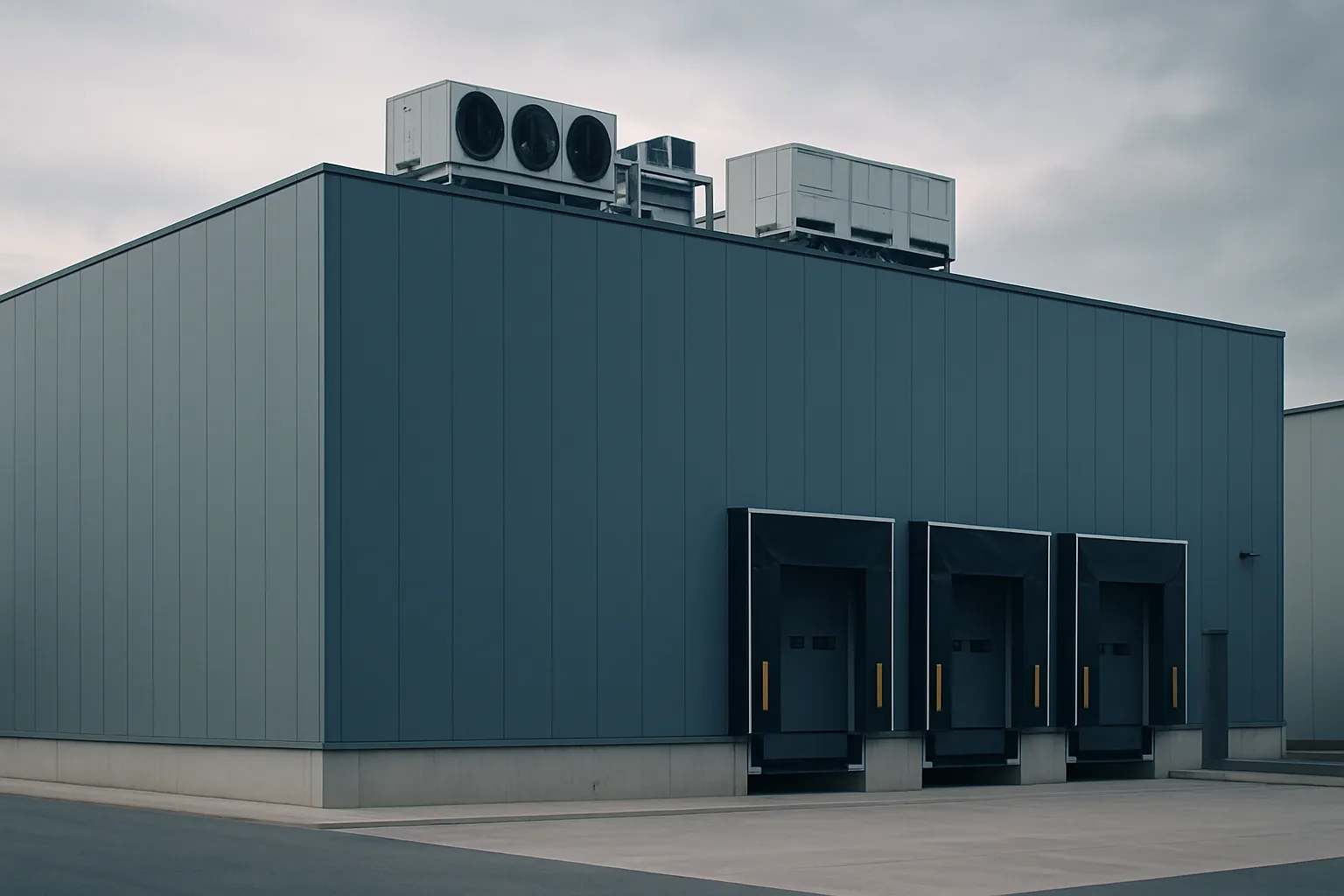
Cold storage finance
Funding for temperature-controlled warehouses run by specialist operators, where fit-out cost and plant are central to value.

Funding cold storage
A cold storage warehouse is a temperature-controlled industrial unit that holds chilled and frozen goods for food producers, grocery operators, pharmaceutical firms and specialist logistics providers. It carries a far higher fit-out cost than a standard shed because of refrigeration plant, insulation, racking and power, and it is usually run by an experienced operator with the technical capability to manage it.
The specialist nature of these assets makes them less liquid than standard logistics units, and a building fitted for one operator may need significant reconfiguration for another. Income is therefore closely tied to the operator and the lease, and the high embedded cost of the plant is a key part of both value and the loan to value (LTV) a lender will set on a commercial mortgage.
What we fund
- Chilled and frozen temperature-controlled facilities
- High specification refrigeration plant, insulation and racking
- Heavy power supply and resilient plant for continuous running
- Operators in food, grocery and pharmaceutical logistics
- Purpose-built fit-out tied to a specific occupier
Indicative terms
- Typical lot size£5m to £100m
- Purchase LTVUp to ~65%
- Development LTCUp to ~60%
- Typical lease / incomeLong leases to specialist operators
Indicative only. Terms vary by lender, asset and borrower and are not an offer of finance.
Commercial mortgages and development loans for cold stores
We arrange a purchase or investment commercial mortgage against let cold stores, with debt sized to reflect the specialist plant, the operator covenant and a conservative loan to value. For new facilities we source development finance covering both the building and the refrigeration fit-out, recognising the higher cost and the staged commissioning of plant. Where a facility needs re-equipping or repositioning between operators we can arrange bridging, then move clients onto a term commercial mortgage once the income and the operator are settled. We act as arranger and introducer to lenders, not as a lender.
Which lenders fund specialist cold storage
A narrower group of lenders is comfortable with cold storage because the assets are specialist and less liquid than standard sheds. Underwriting weighs the operator covenant and track record heavily, alongside the condition and remaining life of the refrigeration plant and the lease length. Lenders take a cautious view on residual value given how purpose-built these buildings are, so loan to value tends to be more conservative than for a generic logistics industrial unit.
The cold storage market
Cold storage does not have a current standalone published rent or yield series, so we keep our market commentary for this class qualitative and note that no standalone rent or yield data exists for the sub-type. As a guide to the wider sector, national prime big-box rent was £11.90 per sq ft in June 2025 per Colliers and prime distribution yields held at 5.00 to 5.25 percent in December 2025 per Knight Frank, but cold stores trade off operator and plant fundamentals rather than these headline logistics benchmarks. Tight overall supply, with development completions at around 16m sq ft in 2025, the lowest since 2018 per Knight Frank, is a supportive backdrop for specialist space.
Finance that suits this asset class
- Purchase and investment financeBuying let cold stores on operator and lease strength.
- Development financeFunding the building and the refrigeration fit-out.
- Bridging financeRe-equipping or repositioning between operators.
- Term loansLonger hold debt once operator income is settled.
Useful calculators
Fund a cold storage deal
A view on fundability within one working day.
How much can you borrow against a cold storage warehouse?
Borrowing on a cold storage warehouse is usually more conservative than on a standard shed because the building is specialist and less liquid. We typically arrange a commercial mortgage up to around 65 percent loan to value (LTV) on a let cold store, with the figure shaped by the operator covenant, the lease length and the condition and remaining life of the refrigeration plant.
The high embedded cost of the plant is central to value, but lenders take a cautious view on how much of that cost they would recover if the facility had to be re-equipped for another operator. We size the loan against the operator and lease for an investor landlord, or against the trading business for an owner-occupier, so the loan to value reflects both the income and the specialist nature of the asset.
Because the lender pool is narrower than for a generic shed, matching the deal to a funder comfortable with temperature-controlled assets is part of the work. The right lender will look past the headline specialist risk to the strength of the operator and the lease, which often makes the difference between a conservative loan to value and one that genuinely reflects the income the cold store produces.
What makes cold storage harder to underwrite?
Cold stores carry heavy specialist fit-out, including refrigeration plant, insulation, racking and resilient power, and they are usually tied to one experienced operator. A building fitted for one occupier may need significant reconfiguration for another, which makes these assets less liquid than a generic industrial unit and narrows the group of lenders comfortable with them.
Underwriting weighs the operator covenant and track record heavily, alongside the condition and remaining life of the plant and the lease. Because residual value is harder to rely on, lenders set a more conservative loan to value and look closely at the operator's technical capability to run a continuous, temperature-controlled facility. We present the operator, the lease and the plant condition so lenders can underwrite the income with confidence.
Power resilience is a particular focus. A cold store has to hold temperature continuously, so the standby power, the insulation and the refrigeration capacity all feed into how a lender views the building and its income. A facility with modern, well maintained plant and resilient power reads more favourably than one approaching the end of its plant life, which can shape both the loan to value and the term offered.
What deposit and term can you expect on a cold store?
With investment commercial mortgages on let cold stores commonly sized up to around 65 percent loan to value, the working assumption is a deposit of around 35 percent of value, higher than on a generic shed. Development is more conservative still, often up to around 60 percent loan to cost, with the facility covering both the building and the refrigeration fit-out as plant is commissioned in stages.
Leases to specialist operators tend to be long, which supports the income lenders underwrite. Investment terms commonly run five to ten years, often with a fixed rate for cost certainty over the hold. We map the deposit or equity requirement and the staged drawdown for development at the outset so clients understand the cash profile.
Amortisation tends to feature more on cold storage than on a generic shed, because lenders want the loan to value to fall over the term as the plant ages. That keeps the cash cost a little higher than an interest-only structure but builds in a margin of safety against the specialist, less liquid nature of the asset. We weigh the rate, the term and the amortisation together so the structure suits the operator and the hold.
For an owner-occupier running the cold store as part of its own logistics business, the term is often shaped around the trading company as much as the building, with repayments serviced from the operation rather than a tenant's rent. We set out the deposit, the term and the cash cost at the outset so a specialist operator can plan around the commitment before committing to the facility.
Can you refinance or remortgage a cold storage facility?
Yes. We refinance let cold stores onto a new investment commercial mortgage or term loan once the operator income is settled, commonly to release equity, fix a rate or replace a maturing facility. The loan to value is set against the current rent, the operator covenant and the condition of the plant at the point of refinance.
Where a facility is being re-equipped or repositioned between operators we can arrange bridging to cover the gap, then move clients onto a term commercial mortgage once a new operator is in place and the income is proven. Because lenders weigh plant condition heavily, timing a refinance after re-equipping or a plant overhaul can improve the loan to value available.
Matching the refinance to the right lender matters as much as the timing. The narrower pool of funders comfortable with temperature-controlled assets will read a well maintained cold store on a sound operator covenant more favourably than a generalist would, which is often what allows a refinance to reach a loan to value that genuinely reflects the income rather than the specialist risk alone.
Is cold storage better held as an investment or owner-occupied?
Both routes are common, and the right one depends on the client. A specialist operator may choose to own the facility it trades from, holding the cold store as a long-term asset and servicing an owner-occupier commercial mortgage out of trading cash flow. This gives control over a building that is purpose-fitted to its process, which matters when the refrigeration plant and layout are integral to how the business runs.
For a landlord, a let cold store is an investment sized on the operator covenant and the lease, with rental income covering the debt. Because the building is tied so closely to one operator, lenders look at the same fundamentals either way, weighing the operator's technical capability and the condition of the plant alongside the loan to value.
Cold storage has no standalone published rent or yield series, so we underwrite each asset on its operator, lease and plant rather than headline logistics benchmarks. We arrange owner-occupier mortgages for operators buying their own facility and investment mortgages for landlords holding let stock, structuring each so the loan to value and term suit the way the asset is held.
Worked example: let temperature-controlled facility
Consider an illustrative purchase of a temperature-controlled cold store let to an experienced food logistics operator on a long lease, priced at £20m including the embedded refrigeration plant. At 60 percent loan to value the commercial mortgage would be around £12m, with the investor funding a deposit of roughly £8m. The numbers are illustrative only and a real facility would be sized on the operator covenant, lease and plant condition.
Reflecting the specialist asset and the cautious view lenders take on residual value, the rate would carry a margin above what a generic shed of the same value might attract, on a term of around five to seven years. The long lease and a strong operator covenant support the rental income covering interest. Because cold storage has no standalone published rent or yield series, the lender underwrites this off the operator and the plant rather than a headline logistics benchmark.
Now take the same facility as a new build. If the building shell cost £12m and the refrigeration fit-out a further £6m, a development facility at 55 to 60 percent loan to cost would advance roughly £10m to £11m against the £18m total, drawn in stages as the plant is commissioned. Once the operator is in occupation and the income is proven, the client refinances onto a term commercial mortgage.
Toward the end of the term the investor could remortgage onto a fresh term loan, refinance after a plant overhaul to improve the loan to value, or sell the let facility to a buyer focused on the operator and plant fundamentals. The less liquid nature of the asset means the buyer pool is narrower than for a generic industrial unit, which lenders factor into the loan to value throughout.
To sketch the cash position, on a £12m loan against a £20m facility the investor holds roughly £8m of equity at the outset. If a plant overhaul through the hold refreshed the refrigeration and the operator re-geared the lease, a refinance might lift the loan to value modestly from the original 60 percent, releasing some of that equity, with the figure set by the operator covenant and the updated plant condition rather than a headline logistics yield.
Illustrative worked example only. Figures vary by lender, asset and borrower and are not an offer of finance.
Frequently asked questions
Can you get a mortgage on a cold storage warehouse?
Yes. A cold storage warehouse can be financed with a commercial mortgage, though loan to value (LTV) is usually more conservative than for a standard shed, often up to around 65 percent, because the plant is specialist and the building less liquid. We size the loan against the operator covenant and lease for an investor landlord, or against the trading business for an owner-occupier.
Why is cold storage harder to finance than a standard warehouse?
Cold stores carry heavy specialist fit-out and are tied to a particular operator, which makes them less liquid. Lenders weigh the operator covenant and plant condition closely and tend to set a more conservative loan to value than for a generic industrial unit.
Is there market data on cold storage rents and yields?
No standalone published rent or yield series exists for cold storage, so we treat market commentary for this class qualitatively and underwrite each asset on its operator, lease and plant rather than headline logistics benchmarks.
How does the refrigeration plant affect cold storage lending?
The refrigeration plant is a large part of a cold store's value, but lenders take a cautious view on how much of that embedded cost they would recover if the facility had to be re-equipped for another operator. They weigh the condition and remaining life of the plant alongside the operator covenant and lease, which tends to set the loan to value below that of a generic shed and points development facilities toward a lower loan to cost.
Funding a cold storage asset?
Tell us about the deal and we will come back with a view on fundability and likely terms.