1
Logistics locations
A warehouse and logistics market report for Herefordshire, with the finance we arrange across 1 logistics location in the county.
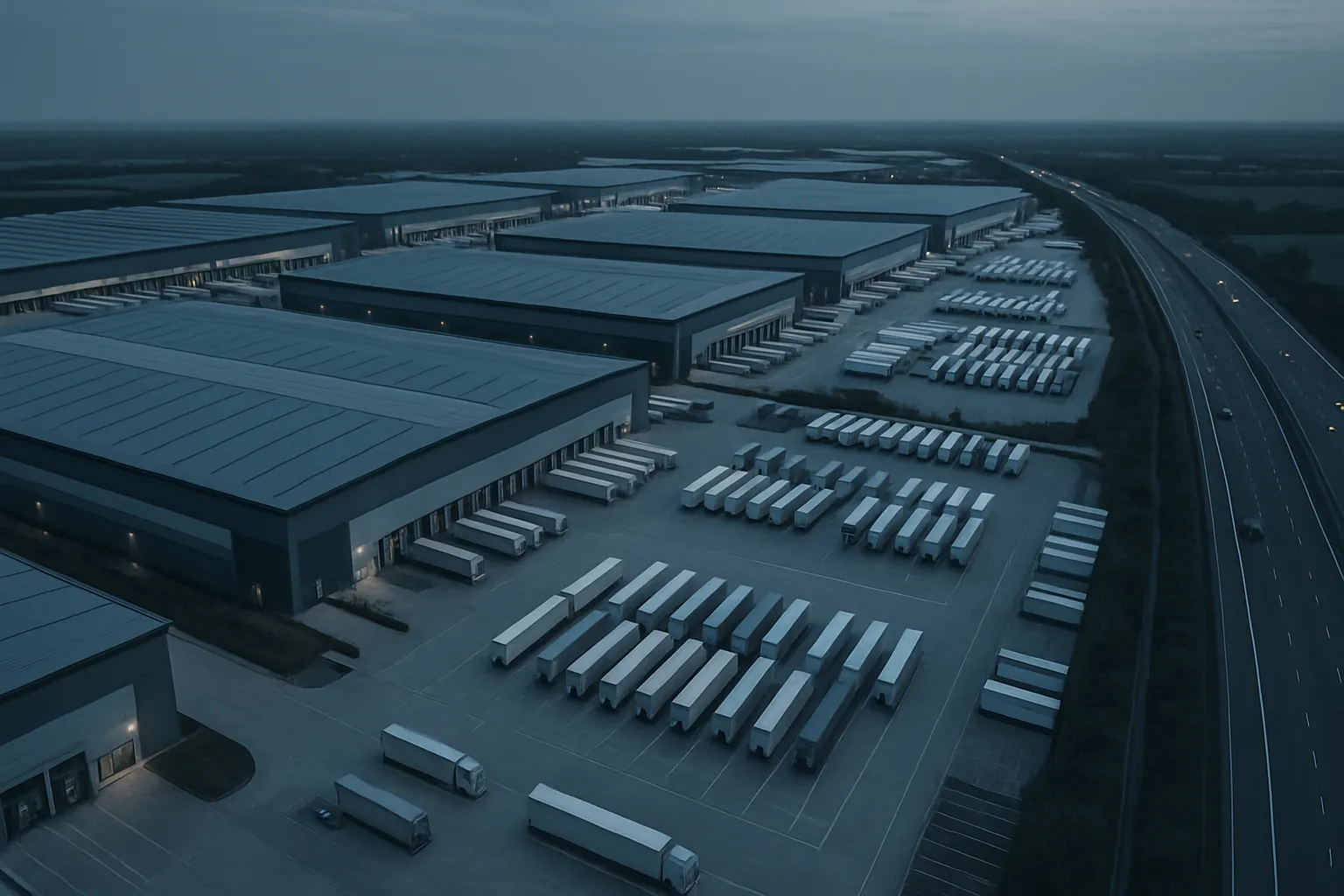
Herefordshire is the most rural industrial market in the West Midlands, with a single significant employment focus at Hereford itself and a road network built around the A49 north to south, the A465 toward Abergavenny and the South Wales valleys, and the A438 east toward the M50 and the wider motorway box. There is no freeport, no strategic rail freight interchange and no large speculative logistics park, so the county sits well outside the national distribution game that defines its eastern neighbours. What it has instead is a concentrated, food and advanced manufacturing economy that needs warehouse and processing space close to where the produce and the workforce are.
The defining cluster is Rotherwas Industrial Estate, including the enterprise zone at Skylon Park, which is the main employment and logistics site immediately south of the city. Rotherwas anchors the bulk of Herefordshire's modern industrial floorspace and is where occupier demand, when it appears, lands. Named occupiers reflect the county's character precisely: Avara Foods and Cargill in poultry and food processing, and Special Metals Wiggin in high performance alloys at Hereford. These are production and supply chain operators rather than third party logistics box users, and that shapes everything about how the local market prices and trades.
Herefordshire's occupier base is unusually specific. Avara Foods and Cargill tie large volumes of chilled, temperature controlled and processing space to the agricultural hinterland, while Special Metals Wiggin represents a long established metallurgical employer whose floorspace is purpose built and effectively non substitutable. This is a manufacturing weighted market, which sits with the national picture in which manufacturing was the largest single occupier type in 2025 at around 33 percent of take-up (Savills). The practical consequence is that demand here is driven by expansion and reinvestment among existing operators rather than by new entrants chasing motorway frontage.
Because the demand is rooted in production, it is also stickier and less cyclical than pure logistics demand. Operators with sunk capital in food lines or alloy plant do not relocate easily, which supports occupancy and rent collection through a downturn. The flip side is a shallow pool of comparable transactions, so evidence for valuation and for lending is thinner than in a Tamworth or a Rugby, and individual lettings move the dial.
Rotherwas Industrial Estate, with Skylon Park as its enterprise zone component, is where Herefordshire concentrates serviceable, consentable industrial land south of Hereford. The enterprise zone status matters because it provides a planning and incentive framework that can bring forward grade A units in a market that would otherwise see very little speculative development. For a county of this size, having a single clearly designated growth location simplifies the supply story: new stock is broadly synonymous with Rotherwas and Skylon Park.
The risk that comes with concentration is correlation. With one dominant estate, vacancy, infrastructure constraint or a single occupier's departure has an outsized effect on headline metrics. That argues for underwriting Rotherwas assets on the strength of the individual covenant and the building's reusability rather than on a deep local market that does not really exist.
Herefordshire does not generate enough institutional grade transactions to set its own prime rent or yield, so the relevant reference points come from the wider West Midlands market, where prime rent is around £11 per sq ft and prime yield around 5 percent, with regional take-up of about 2.35m sq ft and availability of about 10.04m sq ft (Cushman & Wakefield, Q2 2025). In practice Herefordshire prices below those prime levels: the absence of motorway frontage, the distance from the Golden Triangle and the limited tenant pool all justify a rural discount on rent and a softer yield than core regional stock.
Nationally, prime industrial yields have held in the region of 5.00 to 5.25 percent (Knight Frank, December 2025), with secondary closer to 6 percent. Herefordshire's better assets sit toward or beyond that secondary range. The 2026 rental growth forecast of roughly 2.7 to 2.9 percent is a national average that this market is unlikely to match on prime, though specialist food and processing units with committed occupiers can outperform because supply of suitable space is so scarce.
The investment case in Herefordshire rests on income quality rather than capital growth or liquidity. Assets let to Avara Foods, Cargill or Special Metals Wiggin offer long, defensible income from operators embedded in the local economy, but exit liquidity is constrained and a vacant specialist building can be slow and expensive to re-let or repurpose. Valuations should therefore lean on covenant strength, lease length and the alternative use value of the site, not on an assumption of continuous tenant demand.
For standard industrial units at Rotherwas, the value driver is flexibility: multi let estates and generic warehouse boxes carry less re-letting risk than bespoke processing plant and will trade closer to regional norms. The wider context of vacancy running near 7.5 percent against a roughly 4.6 percent ten year average (Knight Frank) is a national caution, but in a thin market like this the local reality is property specific rather than index driven.
We expect Herefordshire to remain a low volume, income driven market through 2026, with activity concentrated at Rotherwas and Skylon Park and demand led by food processing and specialist manufacturing rather than national logistics. Rental growth will trail the regional and national averages on generic stock but can hold up on scarce, fit for purpose processing space. The investment story is about secure income and careful asset selection, not capital appreciation, and lending should be sized to reflect both the strength of named occupiers and the limited liquidity if a specialist building has to be re-let.
Market figures are West Midlands-level benchmarks attributed to Cushman & Wakefield (Marketbeat Logistics & Industrial, Q2 2025), used as regional context for Herefordshire rather than a county-specific measurement. National figures: VOA and the research houses as cited.
Each town carries its own logistics geography and regional market context.
Five products across the whole warehouse lifecycle.
We arrange funding to acquire let warehouse and industrial investment assets across the UK.
We arrange fast, short-term bridging to secure or reposition warehouse and industrial assets.
We arrange funding for ground-up logistics and industrial schemes and major refurbishment.
We arrange funding to carry a newly completed or part-let warehouse through to full occupancy.
We arrange long-term investment mortgages on stabilised, income-producing warehouse assets.
Every sub-type is underwritten differently. We know which lenders back each one.
Send us the outline and we will come back with a view on fundability and likely terms.