6
Logistics locations
A warehouse and logistics market report for Hampshire, with the finance we arrange across 6 logistics locations in the county.
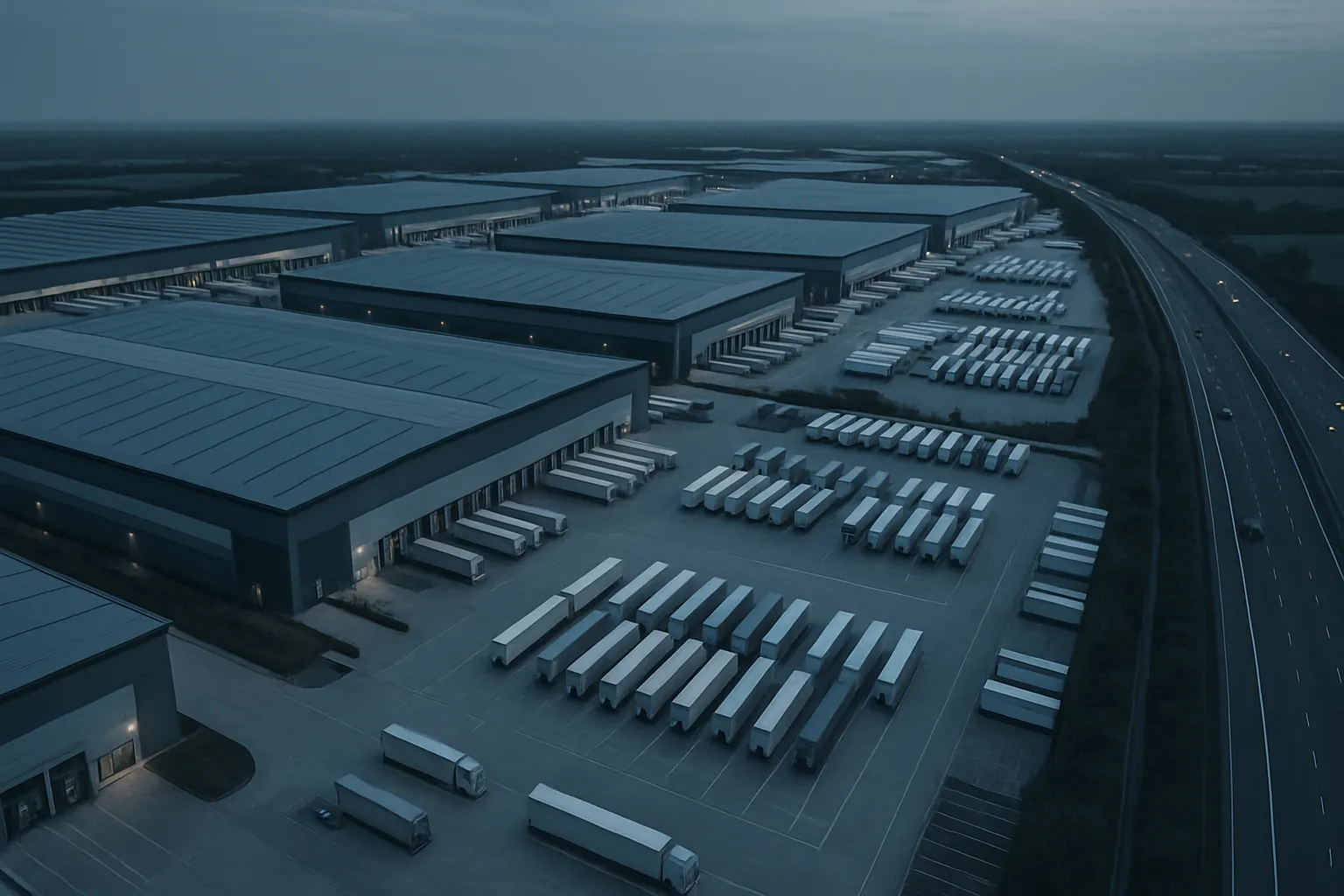
Hampshire is the South East's most port-oriented industrial market, built around the Port of Southampton and the wider Solent. The Port of Southampton is one of the UK's busiest container and vehicle ports, with on-site rail freight terminals linking directly to the national network, and it draws a deep cluster of logistics, shipping and distribution occupiers including DP World, DSV, Portico Shipping, All4 Logistics and Associated British Ports. That port gravity, layered onto the M3, M27, A34 and A303 road network, gives Hampshire a more industrial and freight-led character than its inland neighbours.
The occupier base spreads well beyond the port. Manufacturers such as Twinings, Le Creuset and Stannah sit alongside grocery and retail distribution from Ocado, Booker, Sainsbury's, Marks & Spencer, B&Q, Lidl and John Lewis, and parcel operators DPD and Evri. With six significant towns from Southampton and Portsmouth on the coast to Andover, Basingstoke, Eastleigh and Fareham inland, Hampshire offers more genuine industrial breadth than almost any other county in the region.
The Solent Freeport is the defining policy feature of the Hampshire market. It operates across the wider Solent area with a customs site at Portsmouth International Port, a tax site at Dunsbury Park near Havant and the ABP Redbridge tax site beside the Port of Southampton. Freeport status brings customs and tax advantages that materially change the economics of occupation and development at the designated sites, and it concentrates much of the county's forward-looking investment and development interest around the ports.
For occupiers handling imported goods, the customs and rates advantages at the freeport sites can be decisive, pulling port-centric logistics and manufacturing toward Southampton, Portsmouth and Havant. For investors and developers, the freeport designations identify where the strongest demand tailwinds sit, and they make the difference between a standard logistics scheme and one with an enduring fiscal edge over competing locations elsewhere in the South.
Hampshire's industrial map is organised around the Port of Southampton and the motorway corridors feeding it. Nursling and the Western Docks form a logistics zone stretching from the M27 to the Southampton container terminals, and the port's on-site rail freight terminals give occupiers an intermodal option that most South East markets lack. The Portsmouth Gateway Cluster combines a customs zone at Portsmouth International Port with Dunsbury Park at Havant, extending the freight story along the coast.
Inland, the picture is more about regional distribution and manufacturing. Walworth Business Park sits on the eastern edge of Andover next to the A303, Basingstoke's Houndmills area lies about three miles from Junction 6 of the M3, and Eastleigh sits in the M3 and M27 corridor near Southampton Airport at Junction 5 of the M27, with B&Q headquartered in the town. The Solent Enterprise Zone at Daedalus across Fareham and Gosport focuses on aviation, marine and advanced manufacturing, adding a specialist dimension to the county's offer.
The regional Cushman & Wakefield benchmark for the South East and East in Q2 2025 put prime rents near 23.50 pounds per sq ft, a prime yield around 4.9 percent, take-up of 1.63m sq ft and availability of 12.04m sq ft. Hampshire's port-adjacent prime stock around Southampton and Portsmouth trades toward the keener end of that range, while inland towns such as Andover and Basingstoke sit a step behind on both rent and yield.
National context reinforces the case for the well-located stock. Prime industrial yields held in the 5.00 to 5.25 percent range to December 2025 (Knight Frank), manufacturing was the largest occupier type in 2025 at around 33 percent of take-up (Savills), and the 2026 rental-growth forecast sits at roughly 2.7 to 2.9 percent. Hampshire's strong manufacturing presence, from Twinings and Le Creuset to the advanced manufacturing focus at Daedalus, aligns it with the most resilient slice of national demand.
Development in Hampshire concentrates where freeport status, port access and available land overlap: the Southampton Western Docks and Nursling zone, Dunsbury Park at Havant, and the Daedalus enterprise zone across Fareham and Gosport. These are the locations where new logistics, port-related and advanced manufacturing floorspace can be justified, and where the fiscal incentives improve development returns enough to overcome the county's land and infrastructure constraints.
For asset values the freeport and port-adjacent sites carry the strongest reversionary rental case and the keenest pricing, supported by intermodal rail and customs advantages that are hard to replicate. Inland regional distribution stock at Andover, Basingstoke and Eastleigh offers solid income at a modest discount, while older secondary units, trading nearer the national 6 percent secondary yield, face the usual obsolescence pressure as occupiers demand more power, better access and improved sustainability ratings.
We arrange industrial property finance throughout Hampshire as an introducer to lenders, and the county's freeport and port dynamics shape how we structure debt. For investment purchases of let logistics and manufacturing stock around Southampton, Portsmouth and the Solent Freeport sites, we place senior loans that draw on strong covenants and the freeport demand tailwind to secure competitive leverage and pricing.
Where transactions need to move quickly, an off-market port-side unit, an auction lot or a property bought with vacant possession for refurbishment, we arrange bridging that completes at pace and is built to convert into term debt once income is restored. For ground-up development, including freeport-designated schemes at Dunsbury Park, the Western Docks logistics zone and advanced manufacturing space at Daedalus, we structure development funding that releases against build milestones and accounts for the customs, infrastructure and rail-connection works these sites can involve.
As schemes complete and let, we refinance from development or bridging onto stabilisation and then long-term investment loans, using proven income and any freeport advantage to improve loan-to-value and margin. Across purchase, bridging, development, stabilisation and term funding we match the structure to whether an asset sits in a freeport zone, on the port estate or in the inland distribution corridor, because each carries a distinct demand and pricing profile.
Hampshire is well placed to outperform much of the region thanks to the Solent Freeport, the Port of Southampton's intermodal connectivity and a deep manufacturing base that aligns with the most resilient national demand. Development and capital will keep concentrating on the freeport and port-adjacent sites, where fiscal advantages support new build, while inland distribution stock offers steadier income. With the 2026 rental-growth forecast around 2.7 to 2.9 percent, the county's best-located freight and manufacturing assets look set to hold value firmly.
Market figures are South East-level benchmarks attributed to Cushman & Wakefield (Marketbeat Logistics & Industrial, Q2 2025), used as regional context for Hampshire rather than a county-specific measurement. National figures: VOA and the research houses as cited.
Each town carries its own logistics geography and regional market context.
Five products across the whole warehouse lifecycle.
We arrange funding to acquire let warehouse and industrial investment assets across the UK.
We arrange fast, short-term bridging to secure or reposition warehouse and industrial assets.
We arrange funding for ground-up logistics and industrial schemes and major refurbishment.
We arrange funding to carry a newly completed or part-let warehouse through to full occupancy.
We arrange long-term investment mortgages on stabilised, income-producing warehouse assets.
Every sub-type is underwritten differently. We know which lenders back each one.
Send us the outline and we will come back with a view on fundability and likely terms.