9
Logistics locations
A warehouse and logistics market report for Greater Manchester, with the finance we arrange across 9 logistics locations in the county.

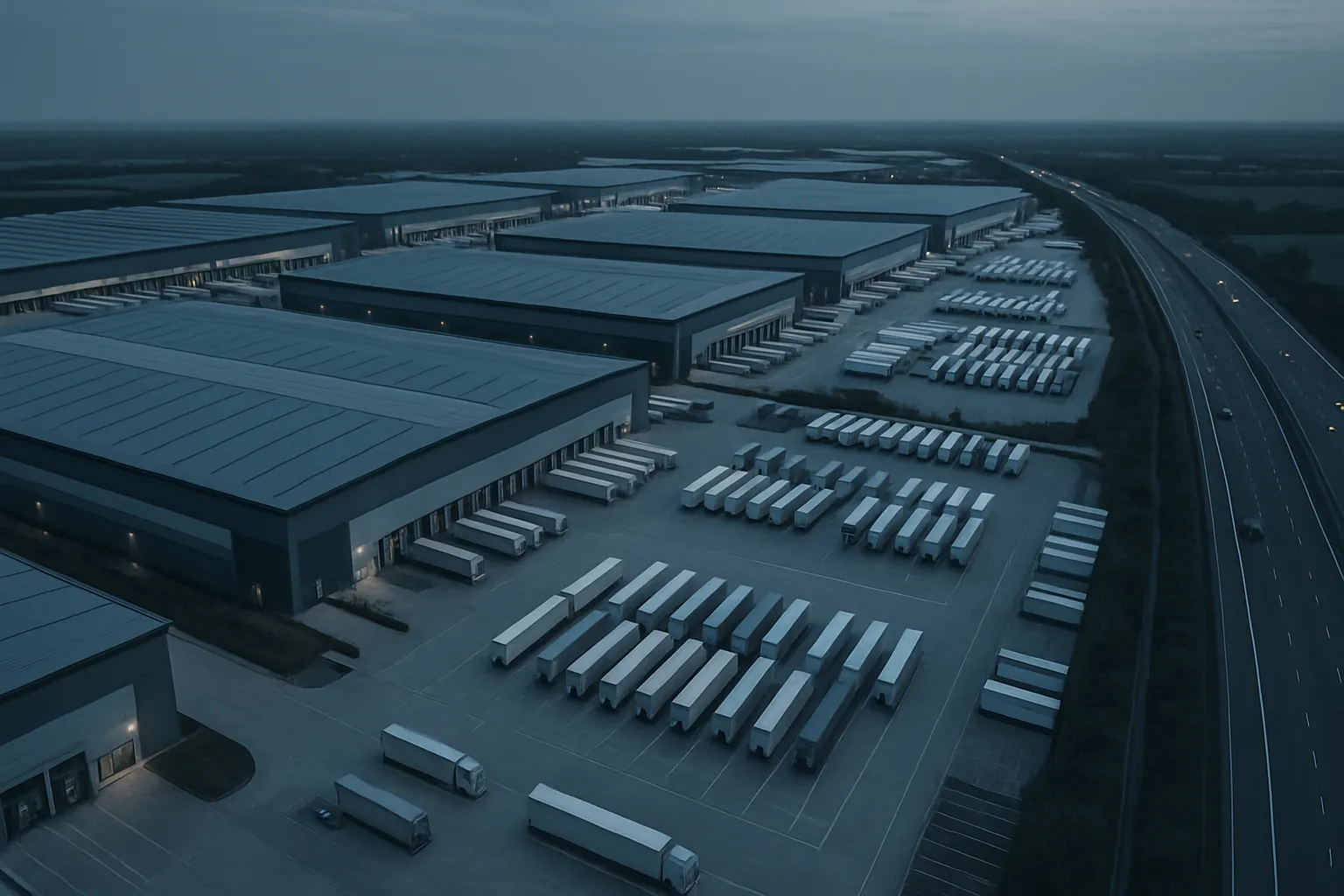
Greater Manchester is the largest and most liquid industrial market in the North West, and one of the most important regional logistics economies in the United Kingdom. The M60 orbital, the M62 and the M61 ring the conurbation and connect Trafford Park, Salford, Wigan and the established towns of Bolton, Bury, Oldham, Rochdale and Stockport. The occupier roster reads like a directory of national distribution and consumer brands: Amazon, Aldi, Lidl, JD Sports, DHL, Wincanton, Dachser, Culina Group, Great Bear, Rhenus Logistics, Kellogg's, Adidas, Unilever, Kraft Heinz and Arrow XL all operate here, alongside the defence manufacturer MBDA.
Trafford Park, the world's first purpose-built industrial estate, remains the principal logistics hub and still hosts over 1,300 businesses on the M60. Around it, Logistics North off M61 Junction 4 is one of the largest commercial developments in the region, Kingsway Business Park off the M62 houses the JD Sports distribution centre, and Port Salford has opened as the UK's first inland tri-modal port on the Manchester Ship Canal. The combination of historic estate depth, modern motorway-frontage parks and tri-modal port connectivity makes Greater Manchester structurally distinct from every other North West county.
Greater Manchester's defining demand driver is the M60 orbital motorway, which encircles the conurbation and gives logistics occupiers near-uniform access to a population of millions within a short drive. Trafford Park sits on the M60 and remains Manchester's principal logistics hub, while Broadway near M60 Junction 22 and Bredbury Park near M60 Junction 25 provide established distribution and light-industrial floorspace east of the city. The orbital is supplemented by the M62 running east to west and the M61 to the north west, so occupiers can serve both the city region and the wider north from a single base.
The occupier base is exceptionally diversified, which underpins the market's liquidity. Grocery and discount retail (Aldi, Lidl, Kraft Heinz, Kellogg's, Unilever), e-commerce and parcels (Amazon, JD Sports, Whistl, Arrow XL), and third-party logistics (DHL, Wincanton, Dachser, Culina, Great Bear, Rhenus) all compete for space, while MBDA adds defence manufacturing. This breadth means no single sector dominates demand, so the market is less exposed to a downturn in any one occupier type than smaller, more concentrated counties.
The geography of supply in Greater Manchester is layered. Trafford Park is the historic core, the world's first planned industrial estate, and despite its age it remains intensively occupied because of its M60 frontage and its critical mass of over 1,300 businesses. Logistics North off M61 Junction 4 is one of the largest commercial developments in the North West and has absorbed much of the modern big-box demand, while Kingsway Business Park off the M62 has drawn major operators including the JD Sports distribution centre.
Symmetry Park at M6 Junction 25 provides large-scale logistics floorspace alongside the Heinz Kitt Green plant, and Pilsworth Industrial Estate near M66 Junction 3 represents the established mid-market in Bury. Port Salford, the UK's first inland tri-modal port on the Manchester Ship Canal, adds rail and water connectivity through the Port Salford rail freight terminal and ties the conurbation into the Liverpool City Region Freeport regime. This layering of historic, modern and multimodal supply lets occupiers of every size and specification find space, which is exactly what sustains the county's status as the regional prime location.
Greater Manchester is the engine of the North West market, where prime rents stand at around £11 per sq ft and prime yields at about 4.8 percent (Cushman & Wakefield, Marketbeat Logistics & Industrial, Q2 2025). As the regional prime location, the best Manchester stock, on Trafford Park, Logistics North or the modern M62 and M6 parks, will trade at or inside those regional prime levels, with the strongest covenants and longest leases setting the keenest yields. Regional take-up of 1.85m sq ft against 11.43m sq ft of availability (Cushman & Wakefield, Q2 2025) confirms an active occupier market with reasonable choice.
The national context is supportive of values. Prime big-box rents reached around £11.90 per sq ft in mid 2025, up 5.2 percent year on year (Colliers, Jun 2025), and 2025 take-up ran at around 40.8m sq ft on a 50,000 sq ft and above basis (Knight Frank). With development completions at around 16m sq ft, the lowest since 2018 (Knight Frank), and national vacancy at about 7.5 percent against a 4.6 percent ten-year average, the supply correction is most favourable to dominant prime markets such as Greater Manchester, where any tightening of the pipeline feeds directly into rental growth.
Institutional and development capital in the North West concentrates first in Greater Manchester, because the depth of the occupier base and the liquidity of the investment market reduce the risk of both letting and exit. The modern motorway-frontage parks, Logistics North, Kingsway, Symmetry Park and the Port Salford tri-modal scheme, attract the speculative and build-to-suit big-box capital, while Trafford Park and the established estates at Bredbury, Broadway and Pilsworth offer income-led and value-add stock with higher running yields.
For asset values, Greater Manchester behaves like a core institutional logistics market. Prime, well-let units underwrite tightly and benefit most from the constrained national pipeline and the 2.7 to 2.9 percent rental-growth forecast for 2026. The established multi-let estates, particularly older Trafford Park stock and the eastern industrial areas, present a different proposition: higher yields, reversionary rent potential as leases roll, and refurbishment angles, but with the need to underwrite against the regional availability figure. The breadth of the market means there is an asset, and a buyer, at almost every point on the risk spectrum.
We arrange the full range of industrial property finance across Greater Manchester, working as an introducer to the lenders most active in this core regional market. For investment purchases of let stock on Trafford Park, Logistics North, Kingsway or the M6 and M62 parks, we place senior term debt sized against income, covenant and lease length, and because this is the regional prime location we can typically access the most competitive leverage and pricing the North West offers. Owner-occupiers acquiring manufacturing, trade-counter or multi-let estate premises across Bolton, Bury, Oldham, Rochdale and Stockport can be funded on commercial mortgage terms supported by trading cash flow.
For time-sensitive acquisitions we use bridging finance to secure assets at auction, to complete ahead of a letting, or to fund refurbishment and repositioning of older Trafford Park and eastern-corridor stock before a term refinance. On the modern parks we structure development funding that draws against build milestones for speculative and build-to-suit big-box schemes, followed by stabilisation finance once practical completion and initial lettings are in place, and then long-term investment debt against the stabilised income. Given the depth of lender appetite for this market, our role is to run a competitive process and structure the facility, leverage and exit that best fit each asset's position on the prime-to-value-add spectrum.
Greater Manchester will remain the dominant industrial market in the North West and a core national logistics location. Its diversified occupier base, the depth of supply from Trafford Park to the modern motorway parks, and tri-modal connectivity at Port Salford give it resilience that smaller counties cannot match. With national development completions at their lowest since 2018 and rental growth forecast at around 2.7 to 2.9 percent for 2026, the constrained pipeline should feed directly into prime values here, and we expect lender appetite to stay strongest in the region for both well-let prime stock and credible development across the motorway frontages.
Market figures are North West-level benchmarks attributed to Cushman & Wakefield (Marketbeat Logistics & Industrial, Q2 2025), used as regional context for Greater Manchester rather than a county-specific measurement. National figures: VOA and the research houses as cited.
Each town carries its own logistics geography and regional market context.
Five products across the whole warehouse lifecycle.
We arrange funding to acquire let warehouse and industrial investment assets across the UK.
We arrange fast, short-term bridging to secure or reposition warehouse and industrial assets.
We arrange funding for ground-up logistics and industrial schemes and major refurbishment.
We arrange funding to carry a newly completed or part-let warehouse through to full occupancy.
We arrange long-term investment mortgages on stabilised, income-producing warehouse assets.
Every sub-type is underwritten differently. We know which lenders back each one.
Send us the outline and we will come back with a view on fundability and likely terms.