1
Logistics locations
A warehouse and logistics market report for Glasgow, with the finance we arrange across 1 logistics location in the county.

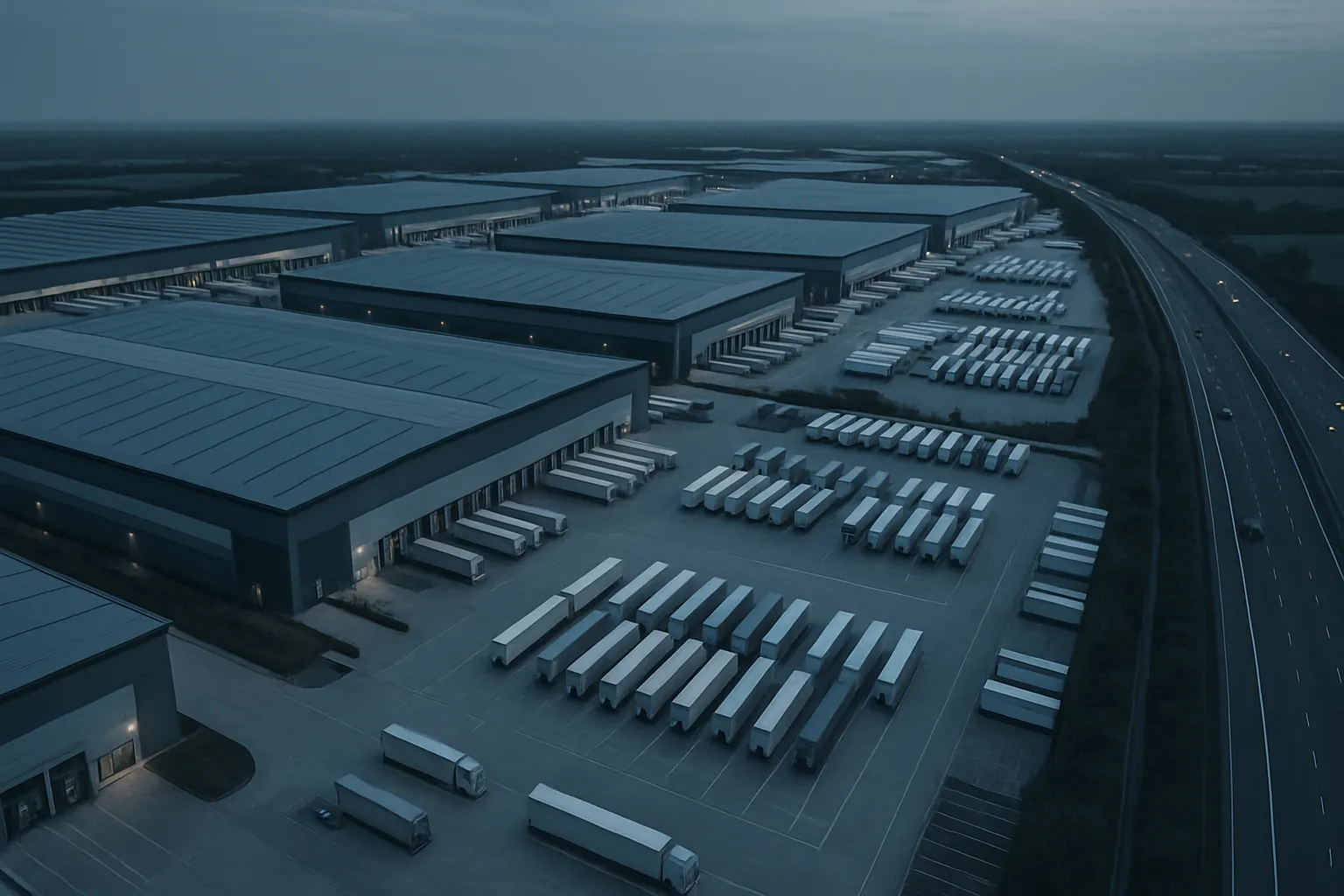
Glasgow is the larger of Scotland's two metropolitan industrial markets and the natural distribution centre for the west of the country. The city is wrapped in motorway infrastructure, with the M8 running through its heart at Junctions 15 and 22, the M74 arriving from the south at Junction 1, the M77 feeding in from the south-west and the A82 heading north-west toward the Highlands. That density of strategic road access is what makes Glasgow the default location for occupiers needing to serve the west-central Scottish population from a single point.
The headline occupiers, DHL and Amazon, reflect the city's role as a logistics and last-mile hub serving a large urban catchment. The defining industrial asset is Hillington Park, the first and largest industrial estate of its kind in Scotland and today home to more than 500 organisations across logistics, manufacturing and engineering. Hillington's scale and longevity make it the backbone of the Glasgow industrial market and a useful proxy for the health of west-central Scottish industrial demand as a whole.
Glasgow's industrial geography is dictated by the motorway box. The M8 corridor through Junctions 15 and 22, the M74 spur from the south and the M77 from the south-west create a tight grid of accessible industrial land close to a dense population, which is exactly the profile that urban logistics and last-mile operators such as DHL and Amazon need. Proximity to consumers, not to a national crossroads, is the demand driver here; Glasgow is about serving the west of Scotland quickly rather than acting as a UK-wide fulfilment hub.
That urban character has consequences for supply. Industrial land inside the motorway box competes directly with higher-value uses and is constrained by the built-up nature of the city, so genuinely well-located space is scarce and tightly held. The result is a market where modern, well-connected units command a premium and where the shortage of available large-format space close to the city is a structural feature rather than a passing cyclical squeeze.
Hillington Park does a lot of work in this market. As the first and largest industrial estate of its kind in Scotland, with more than 500 organisations spanning logistics, manufacturing and engineering, it functions as both the physical centre of gravity for west-central Scottish industry and a barometer of demand. Its diversity of occupiers means it is not hostage to any single sector, which gives it a resilience that newer, more specialised estates lack.
For property purposes, an estate of that scale and mix supports a deep and liquid rental market, with regular letting evidence across unit sizes and uses. That liquidity matters for valuation and for lending, because it produces reliable comparables and a steady churn of demand. The flip side is that much of Hillington's stock is mature, so there is a continuous refurbishment and repositioning requirement to keep older units lettable against the standards modern occupiers expect.
Scotland-wide prime industrial rents stand at around 9.50 pounds per sq ft with prime yields near 6 percent, on Cushman and Wakefield's Q2 2025 reading, with regional take-up of roughly 0.09m sq ft and availability of about 3.37m sq ft. As one of the two principal Scottish markets, Glasgow sits at the firmer end of that range: constrained urban supply and strong last-mile demand support prime rents at or above the regional figure and keep prime yields toward the keener end for the best-located stock.
The central tension is supply. With limited developable land inside the motorway box and constrained availability across the region, well-specified modern space is hard to come by, which protects rents and rewards owners who can deliver or refurbish quality units near the M8 and M74. The same scarcity pushes some larger-format requirements out to Lanarkshire and Renfrewshire, so Glasgow's pricing power is strongest in the urban-logistics and mid-box segments where location is decisive.
Development in Glasgow is necessarily an infill and regeneration story rather than a greenfield one. The opportunities lie in intensifying and modernising existing industrial land, including the ongoing renewal of established estates such as Hillington, and in capturing last-mile demand on the constrained sites that sit closest to the urban population. Speculative large-format development is harder to justify inside the city than in the surrounding counties, which is why Glasgow's growth in big-box terms tends to spill into Lanarkshire and Renfrewshire.
Value concentrates where access and scarcity meet: modern units with good motorway access and the flexibility to serve last-mile logistics, and well-let positions on established estates with reliable income. The investment logic is to own quality, well-connected stock in a supply-constrained urban market and to add value through refurbishment and re-letting, rather than to chase yield in tired secondary space that struggles to compete for occupiers.
We act as an arranger and introducer of finance across the Glasgow industrial market, not as a lender. For acquisitions of let units on Hillington Park and along the M8 and M74 corridors, we structure investment term loans sized on passing rent, lease length and covenant, taking advantage of the deep letting evidence that an estate like Hillington provides to support valuation and gearing. The Scottish regime applies Land and Buildings Transaction Tax rather than Stamp Duty Land Tax, so we model the LBTT cost on the commercial bands into the acquisition from the start.
For refurbishment and repositioning of mature stock, which is a recurring requirement in this market, we arrange bridging and refurbishment facilities to fund works and bridge re-letting, then refinance onto term debt once income is restored. Where infill or regeneration development is involved, we put development funding in place drawn against costs and certified progress. Because urban voids carry real holding costs, we size empty-property rates exposure using the rateable values held by the Scottish Assessors, ensuring the carry is reflected in the structure from day one.
Glasgow's industrial market should remain one of the firmer in Scotland, underpinned by dense last-mile demand, a constrained urban land supply and the deep, diverse occupier base that Hillington Park exemplifies. The persistent shortage of modern, well-located space will keep prime rents supported and reward owners able to deliver or refurbish quality units near the motorway network, while larger-format requirements continue to flow into the surrounding counties. We expect financing appetite to focus on well-let urban stock and on refurbishment-led value creation rather than on speculative big-box development inside the city.
Market figures are Scotland-level benchmarks attributed to Cushman & Wakefield (Marketbeat Logistics & Industrial, Q2 2025), used as regional context for Glasgow rather than a county-specific measurement. National figures: VOA and the research houses as cited.
Each town carries its own logistics geography and regional market context.
Five products across the whole warehouse lifecycle.
We arrange funding to acquire let warehouse and industrial investment assets across the UK.
We arrange fast, short-term bridging to secure or reposition warehouse and industrial assets.
We arrange funding for ground-up logistics and industrial schemes and major refurbishment.
We arrange funding to carry a newly completed or part-let warehouse through to full occupancy.
We arrange long-term investment mortgages on stabilised, income-producing warehouse assets.
Every sub-type is underwritten differently. We know which lenders back each one.
Send us the outline and we will come back with a view on fundability and likely terms.