2
Logistics locations
A warehouse and logistics market report for Flintshire, with the finance we arrange across 2 logistics locations in the county.
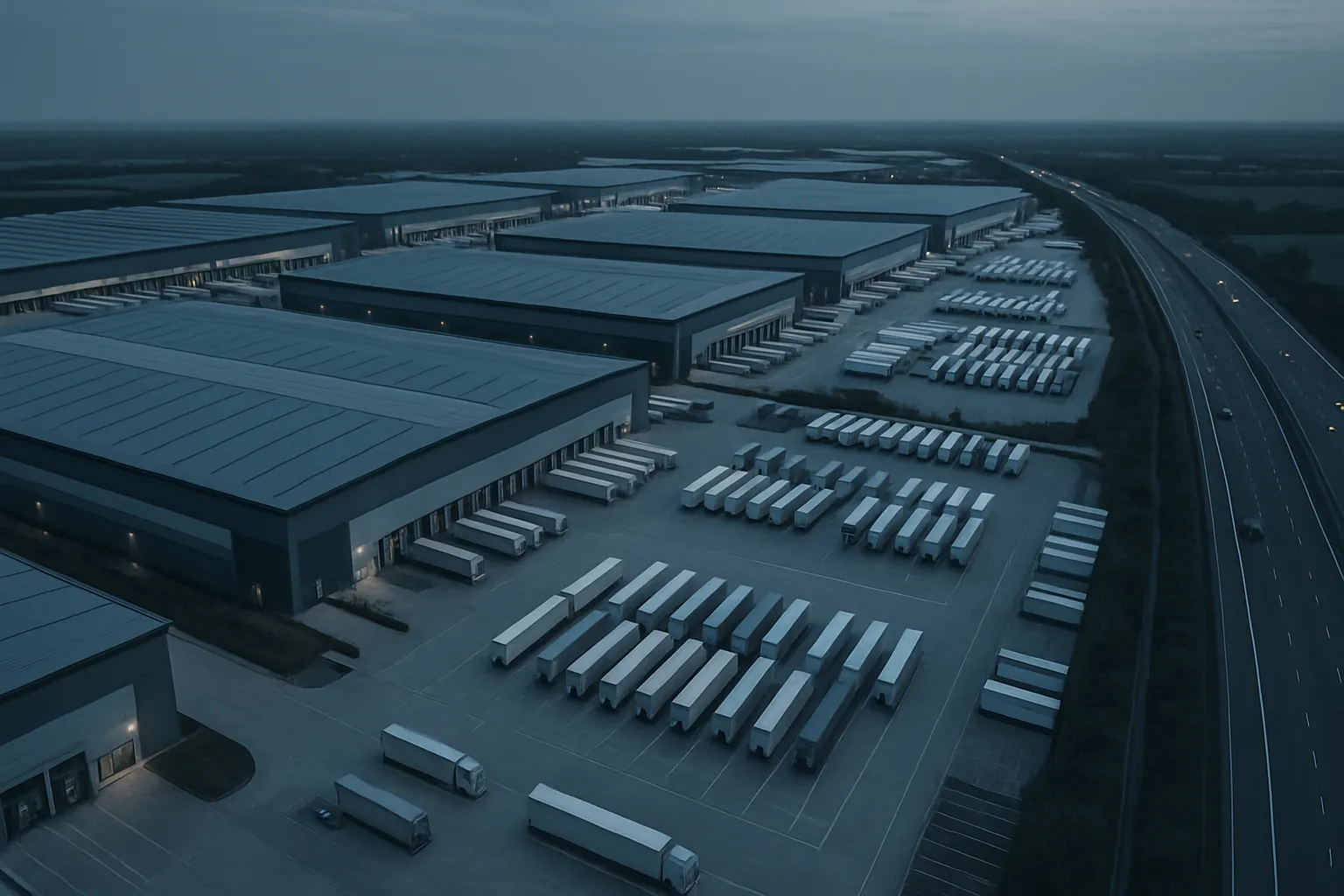
Flintshire is the manufacturing engine of North Wales and the most genuinely cross-border industrial market in the country. Deeside Industrial Park, sitting on reclaimed land beside the Dee estuary, is one of the largest employment sites in North Wales at over 5 million sq ft, and it operates as part of an integrated economy that spills straight across the border into Cheshire and the Wirral. The A55 expressway threads the county at Junctions 33, 36 and 37, the A494 and A548 connect Deeside to the wider network, and the result is a county whose logistics geography is defined by access to both the North Wales coast and the English motorway system at the M53 and M56.
The occupier base is heavyweight and industrial. Toyota's engine plant, Tata Steel, the medical-device manufacturer Convatec, the frozen-food retailer Iceland (headquartered in the county) and Great Bear Distribution anchor a market built on advanced manufacturing, food and contract logistics rather than pure e-commerce fulfilment. Aber Park in Flint provides additional industrial space, but Deeside is overwhelmingly the centre of gravity.
Flintshire's demand profile is unusual for Wales in that it is led by production rather than distribution. Toyota's engine manufacturing, Tata Steel's processing operations and Convatec's medical-device output give Deeside a base of large, capital-intensive occupiers who value the site for its scale, its skilled labour pool and its proximity to both Welsh and English supply chains. Iceland's headquarters and Great Bear's contract-logistics presence add a substantial food and distribution layer on top.
This manufacturing weighting matters because manufacturing was the largest single occupier type in the national market in 2025 at around 33 percent of take-up (Savills), and Flintshire is one of the places where that demand is genuinely concentrated. Occupiers here tend to commit to long horizons and bespoke buildings, which produces durable, sticky tenancies rather than the rapid churn seen in pure logistics markets.
What sets Flintshire apart is that its market does not stop at the national boundary. Deeside sits minutes from the M53 and the Cheshire and Wirral conurbation, and occupiers routinely weigh a Deeside requirement against alternatives in Ellesmere Port, Chester or the Liverpool City Region. That competition disciplines rents and gives the county a deeper occupier pool than its size alone would suggest.
The border also creates a policy seam that occupiers and investors have to navigate. Property bought in Flintshire attracts Welsh Land Transaction Tax, while an otherwise identical unit a few miles east in Cheshire falls under English Stamp Duty Land Tax, and the two regimes have different rate bands. Welsh business-rates and grant arrangements likewise differ from the English system. For anyone modelling a North Wales acquisition, the Welsh tax position has to be priced in deliberately rather than carried across from an English comparable.
The Wales market tracked by Cushman & Wakefield showed prime rent of around £9 per sq ft in Q2 2025, take-up of roughly 0.24 million sq ft and availability of about 2.92 million sq ft, with prime yields near 6.15 percent. These are regional figures rather than Flintshire-specific data, but they describe a market where rents sit well below the national prime big-box level of around £11.90 per sq ft (Colliers, June 2025) and yields are softer than the UK prime range of 5.00 to 5.25 percent (Knight Frank, December 2025).
Deeside's scale and the quality of its occupier covenants pull it toward the better end of that range. Modern, well-let units on the park, particularly those underpinning long manufacturing or food-logistics leases, attract keener pricing than the regional headline implies, because the income looks more like a corporate covenant than a typical regional industrial let. Older stock and short-income assets sit closer to, or beyond, the national secondary yield of around 6 percent.
For investors, Flintshire offers a relatively rare combination in Wales: institutional-scale buildings let to recognised manufacturing and food covenants. That supports both value and debt availability, because lenders are more comfortable with long income from strong tenants than with speculative regional risk. The flip side is concentration: a market this dependent on a handful of large occupiers carries single-tenant exposure that has to be underwritten carefully.
The cross-border position is a financing advantage as well as a complication. Lenders that already understand the Cheshire and Liverpool City Region markets can extend that comfort across the Dee, which widens the pool of capital available for Deeside assets relative to more isolated Welsh locations. The LTT cost and the Welsh rates position remain inputs that must be modelled explicitly in every appraisal.
We arrange funding across the full range of Flintshire requirements, from owner-occupiers buying production or distribution space at Deeside or Aber Park to investors acquiring let industrial assets. Purchase facilities are typically structured to around 70 to 75 percent of value, with terms that reflect covenant strength and lease length; for the long-income, strong-covenant lets that characterise the better Deeside stock, that can support keener leverage and pricing. Welsh Land Transaction Tax is built into the funding need from the outset.
For occupiers expanding or fitting out manufacturing space we fund capital works alongside the property, and where a transaction needs to move quickly we place bridging finance and refinance onto a term loan once income is stabilised. We arrange development finance for ground-up schemes on the park against cost, with an exit onto an investment facility, and stabilisation funding for newly completed units inside their early-income period. Because the market straddles the border, we draw on lenders comfortable with both Welsh and North West English industrial risk. As an arranger and introducer rather than a lender, our job is to fit the right capital to each case and to price the Welsh tax and yield position accurately.
Flintshire's outlook is the most resilient in Wales, anchored by entrenched manufacturing and food occupiers and a cross-border catchment that deepens demand beyond the county itself. With national manufacturing take-up holding up and the 2026 rental-growth forecast at around 2.7 to 2.9 percent, well-let Deeside stock should see steady rental progression and the potential for yield tightening from the regional 6.15 percent if investor appetite for strong-covenant regional logistics improves. The principal risk is concentration in a small number of large tenants, which makes covenant monitoring and lease-event planning central to protecting value.
Market figures are Wales-level benchmarks attributed to Cushman & Wakefield (Marketbeat Logistics & Industrial, Q2 2025), used as regional context for Flintshire rather than a county-specific measurement. National figures: VOA and the research houses as cited.
Each town carries its own logistics geography and regional market context.
Five products across the whole warehouse lifecycle.
We arrange funding to acquire let warehouse and industrial investment assets across the UK.
We arrange fast, short-term bridging to secure or reposition warehouse and industrial assets.
We arrange funding for ground-up logistics and industrial schemes and major refurbishment.
We arrange funding to carry a newly completed or part-let warehouse through to full occupancy.
We arrange long-term investment mortgages on stabilised, income-producing warehouse assets.
Every sub-type is underwritten differently. We know which lenders back each one.
Send us the outline and we will come back with a view on fundability and likely terms.