8
Logistics locations
A warehouse and logistics market report for Essex, with the finance we arrange across 8 logistics locations in the county.

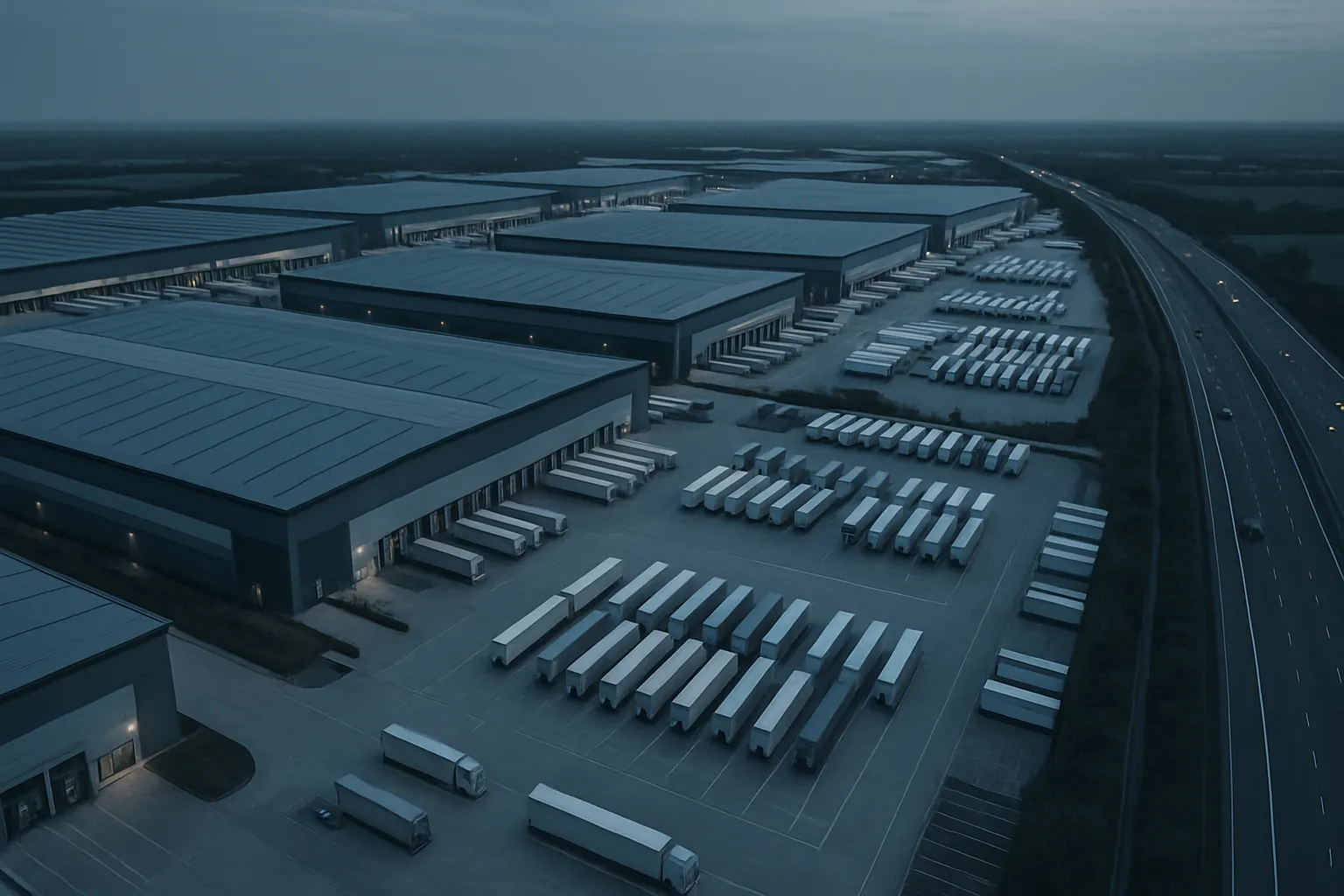
Essex is the East of England's heavyweight logistics county, combining deep-sea container capacity, freeport status and a dense network of established industrial towns. The Thames Estuary alone hosts two of the most significant logistics assets in the country: DP World London Gateway at Stanford-le-Hope, which pairs a deep-sea container port with one of Europe's largest logistics parks and an on-port intermodal rail terminal, and the Forth Ports facility at Tilbury, expanded by the Tilbury2 terminal on the former power station site. Both sit within Thames Freeport, which links London Gateway and Tilbury and carries Tilbury's tax-site incentives.
Beyond the estuary, Essex is criss-crossed by the A12, A13, A120, A130 and A414, with major occupier clusters across Basildon, Braintree, Chelmsford, Colchester and Harlow. The county's tenant base is exceptional in both depth and variety, spanning the ports operators DP World, Forth Ports and Maritime Transport, global logistics names CEVA Logistics, DSV, DHL Supply Chain, Culina Group and Howard Tenens, manufacturers Ford Motor Company, Leonardo, New Holland Agriculture and GlaxoSmithKline, and the offshore and bulk trades handled at Harwich International Port. Harwich is itself one of the two port hubs of Freeport East alongside Felixstowe.
The defining feature of the Essex market is the Thames Estuary port cluster. London Gateway has transformed the south of the county into a national logistics destination, drawing occupiers who want a port-centric supply chain with on-site rail connectivity and the customs and tax advantages of Thames Freeport. The Port of Tilbury, the freeport's other anchor, has added capacity through Tilbury2, reinforcing a corridor that handles both deep-sea containers and bulk and roll-on roll-off trades.
Freeport designation is a material underwriting factor. The customs and tax-site benefits attaching to Thames Freeport, and to Harwich within Freeport East, lower occupancy and operating costs for qualifying users and deepen the pool of port-logistics demand. For investors and lenders, port-adjacent assets at Stanford-le-Hope and Tilbury combine strong covenants, structural demand and the kind of strategic location that supports both income durability and value retention through the cycle.
Away from the estuary, Essex's industrial demand is carried by a network of established towns. Basildon's activity concentrates along the A127 at estates such as Burnt Mills and Cranes Farm; Chelmsford's Dukes Park is the city's principal industrial and warehousing location; and Severalls Industrial Park sits beside the A12 and A120 interchange north of Colchester. Braintree's Horizon 120 has added modern business and logistics space alongside the established Springwood estate, while Harlow's Templefields and Pinnacles estates anchor the county's western edge near the M11.
This town network gives Essex an unusually broad multi-let and mid-box market sitting beneath the headline port assets. It supports a diverse occupier base from Royal Mail, DPD and Screwfix to Brakes, Poundland and Euro Car Parts, and it provides the kind of granular, well-let income that lenders favour. The breadth of the network also spreads risk: no single town dominates, and demand is drawn from manufacturing, trade, parcels and regional distribution alike.
Essex prices off the South East and East regional market, where Cushman and Wakefield reported prime rent of £23.50 per sq ft and a prime yield of 4.9 percent in Q2 2025, with regional take-up of 1.63m sq ft against availability of 12.04m sq ft. Those figures reflect the region's proximity to London and sit far above the national prime big-box rent of around £11.90 per sq ft that Colliers reported for June 2025, up 5.2 percent year on year.
Nationally, Knight Frank put 2025 take-up at around 40.8m sq ft on a 50,000 sq ft and above basis, with vacancy near 7.5 percent against a 4.6 percent ten-year average and completions of about 16m sq ft, the lowest since 2018. Essex's combination of port-driven structural demand and a deep established-town market makes it one of the most liquid logistics counties in the region. Prime port-adjacent and motorway-fronting stock trades at the tight end of the yield range, while older secondary estates sit nearer the 6 percent national secondary level and demand more active management.
Development in Essex concentrates in two arenas: the freeport port parks at London Gateway and Tilbury, where large-format, rail and customs-enabled space is delivered at national scale, and the A12 and A127 town corridors, where modern mid-box and trade schemes such as Horizon 120 supplement the established estates. Harwich International at Bathside Bay adds a specialist dimension geared to bulk trades, car exports and offshore wind operations.
For values, the port parks form the institutional core, underpinned by covenant strength, freeport incentives and structural import-and-distribution demand; these assets command the keenest pricing and the deepest lender appetite. The town network offers a complementary income play, where value is driven by occupancy, rent reversion and the scarcity of well-specified mid-box space rather than by trophy location. The overall effect is a county with both a high-value strategic tier and a broad, resilient income base, which is an attractive combination for both equity and debt.
Essex offers the widest financing canvas in the region, and we structure debt across the whole of it. For investment purchases of port-adjacent assets at London Gateway and Tilbury, we arrange senior term loans that recognise freeport incentives, strong shipping and logistics covenants and the structural demand that comes with deep-sea container flows, with leverage geared to income quality and strategic location. For the established-town network, we place term debt against well-let multi-let and mid-box estates at Basildon, Chelmsford, Colchester and Harlow, where the granular income from names such as Royal Mail, Screwfix and Brakes supports stable senior gearing.
Where deals are time-sensitive or assets need work, we use bridging finance to complete quickly and then refinance onto term once income is secured, and we structure development facilities against build cost and end value for new schemes on the freeport parks and the A12 and A127 corridors, including mid-box product of the Horizon 120 type. As arrangers and introducers, not a lender, we run a competitive process across banks, debt funds and specialist port-and-logistics lenders, and we can blend port-tier and town-network assets within a single facility for portfolio borrowers. The breadth of Essex demand lets us tune leverage tightly to the asset, from keenly priced senior debt on prime freeport boxes to more conservative value-add structures on secondary estates.
Essex has the strongest structural outlook in the region. The Thames Estuary ports, freeport incentives and Harwich's offshore-wind and bulk role give the county demand drivers that are largely independent of the wider property cycle, and they should support stable prime yields and rental growth at or above the national 2026 forecast of roughly 2.7 to 2.9 percent on the best port-adjacent and corridor stock. The established-town network adds liquidity and income diversity. The principal risk is concentration at the very top end, where the fortunes of the largest port parks are tied to global trade volumes, but the breadth of the county's wider market provides a substantial cushion.
Market figures are East of England-level benchmarks attributed to Cushman & Wakefield (Marketbeat Logistics & Industrial, Q2 2025), used as regional context for Essex rather than a county-specific measurement. National figures: VOA and the research houses as cited.
Each town carries its own logistics geography and regional market context.
Five products across the whole warehouse lifecycle.
We arrange funding to acquire let warehouse and industrial investment assets across the UK.
We arrange fast, short-term bridging to secure or reposition warehouse and industrial assets.
We arrange funding for ground-up logistics and industrial schemes and major refurbishment.
We arrange funding to carry a newly completed or part-let warehouse through to full occupancy.
We arrange long-term investment mortgages on stabilised, income-producing warehouse assets.
Every sub-type is underwritten differently. We know which lenders back each one.
Send us the outline and we will come back with a view on fundability and likely terms.