5
Logistics locations
A warehouse and logistics market report for Derbyshire, with the finance we arrange across 5 logistics locations in the county.

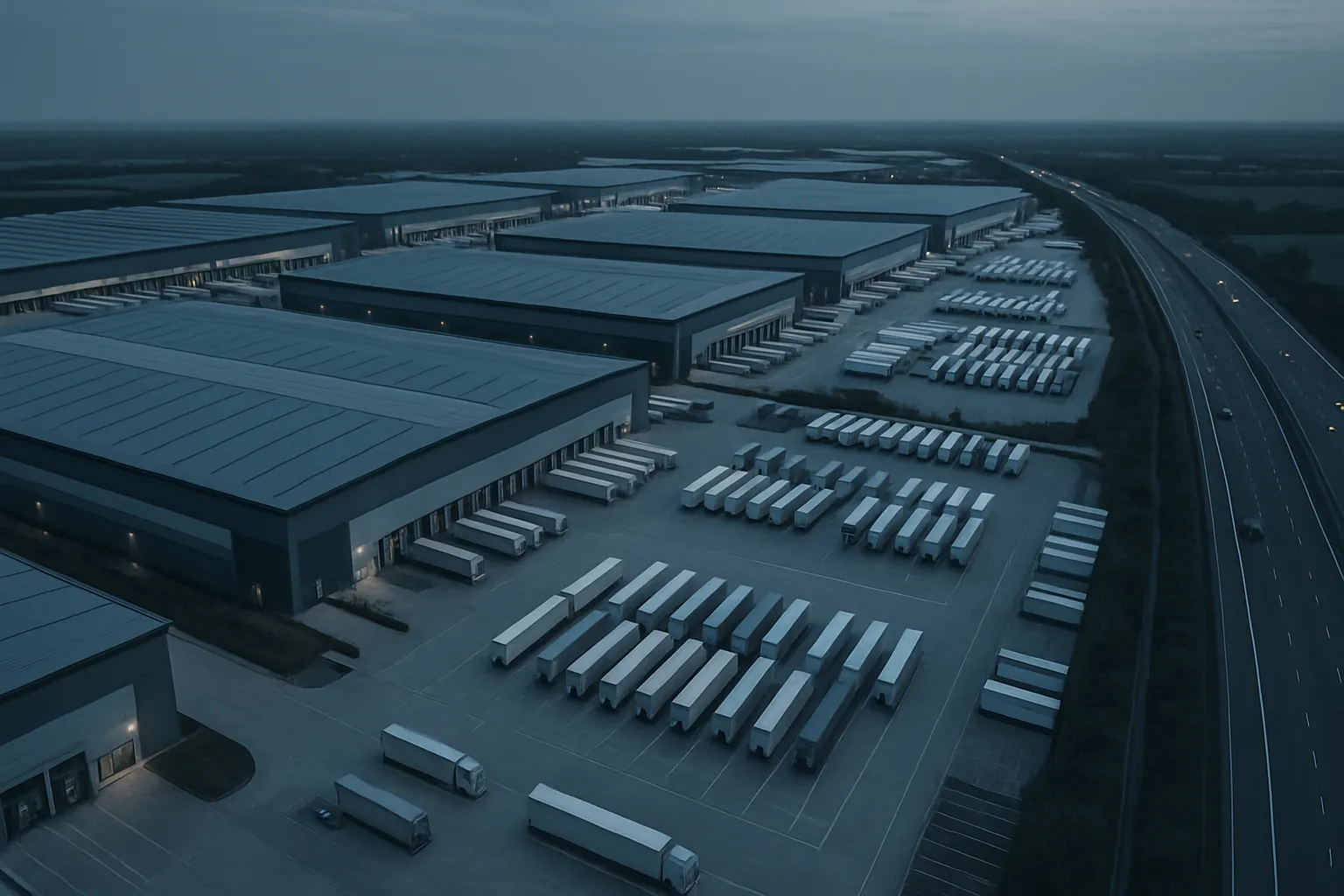
Derbyshire occupies a pivotal position in the East Midlands logistics economy, sitting inside the so-called Golden Triangle of distribution that lets operators reach the majority of the UK population within a single driving shift. The county's industrial geography is organised around the M1, where Junctions 24, 25, 28, 29 and 30 each anchor clusters of distribution and manufacturing floorspace, supported by the A50 trunk route west to Stoke and the A453 link into Nottingham. Castle Donington and Derby form the prime markets, with established activity at Chesterfield, Ilkeston and Swadlincote.
The defining asset is SEGRO Logistics Park East Midlands Gateway, a rail-connected distribution park adjoining East Midlands Airport and served by the East Midlands Gateway strategic rail freight interchange. The county also benefits from inclusion in the East Midlands Freeport, the only inland freeport in England, which overlays customs and tax advantages on Gateway and neighbouring sites. Combined with a deep manufacturing base anchored by Rolls-Royce, Toyota and Alstom, this gives Derbyshire an unusually broad demand profile spanning big-box logistics, advanced manufacturing and parcel networks.
The East Midlands Gateway interchange is the structural advantage that separates Derbyshire from most competing distribution geographies. Intermodal rail connectivity beside a cargo airport allows occupiers to blend container rail, air freight and road in a single location, which is why the park has drawn occupiers of the scale of Amazon, Marks and Spencer, XPO Logistics and DHL. Rail-served big-box assets of this type command the keenest investor pricing in the region because the multimodal access deepens the tenant pool and supports rent durability through cycles.
Beyond the Gateway, development is spreading along the M1 spine. Markham Vale, the county's flagship regeneration park, has its own dedicated junction at M1 J29a and has matured into a substantial employment site. New Stanton Park, a 200-acre rail-connected scheme at Junction 25, adds further big-box and distribution capacity. The pattern is one of large, planned parks rather than incremental infill, which concentrates institutional-grade stock around a small number of strategic interchanges.
Derbyshire is not a pure logistics play. Rolls-Royce in Derby, Toyota at Burnaston and Alstom's rail manufacturing presence give the county a heavy advanced-manufacturing component, alongside Games Workshop, Great Bear and Smurfit Westrock. Nationally, manufacturing was the largest single occupier type in 2025 at around 33 percent of take-up on a big-box basis, per Savills, and Derbyshire is one of the counties where that demand is most visible on the ground.
For lenders and investors, manufacturing covenants behave differently from third-party logistics. They tend to involve fitted-out, capital-intensive plant and long commitments to a site, which supports lease length and reletting prospects but can narrow the universe of alternative occupiers if a unit is heavily bespoke. The blend of pure-shed logistics and embedded manufacturing in Derbyshire allows finance to be structured around either profile depending on the specific asset.
The wider East Midlands market recorded prime rents of £10.50/sq ft, a prime yield of 5.15 percent, take-up of 3.98m sq ft and availability of 16.25m sq ft in Cushman and Wakefield's Q2 2025 Marketbeat. These are regional figures rather than Derbyshire-specific readings, but they frame the county well: rents have pushed up as Grade A logistics has become scarce relative to demand, while availability has risen from the cyclical lows of 2021 to 2022 as speculative completions and tenant releases returned space.
The national backdrop is consistent with this. Prime big-box rents reached around £11.90/sq ft in June 2025, up 5.2 percent year on year per Colliers, while vacancy across the wider market sat near 7.5 percent against a ten-year average of about 4.6 percent, and development completions fell to roughly 16m sq ft in 2025, the lowest since 2018 on Knight Frank's count. For Derbyshire that combination, softer headline vacancy but a thin forward pipeline, points to firming rents on the best rail-served stock even as secondary space takes longer to let.
Prime industrial yields nationally held in the region of 5.00 to 5.25 percent into December 2025 per Knight Frank, with secondary closer to 6 percent. Derbyshire's best Gateway assets price toward the keen end of that range, reflecting rail connectivity, freeport status and institutional ownership. The East Midlands Freeport designation is a genuine value input rather than a marketing label: the customs and tax reliefs available on designated sites can improve occupier economics and, where they attach to a long lease, can support both rent and capital value.
The spread between prime and secondary is the practical issue for owners of older estates at Ilkeston, Chesterfield or Swadlincote. As investors concentrate capital on modern, well-located, ESG-compliant sheds, secondary assets face wider yields and more selective debt. That divergence creates repositioning opportunities, but it also means valuations and loan terms vary sharply across the county depending on age, specification and junction proximity.
We arrange debt across the full life cycle of a Derbyshire industrial asset, and we work as an introducer to the lending market rather than as a principal. For acquisitions of standing investments, whether a single unit on Markham Vale or a Gateway big-box let to a national occupier, we place senior investment loans where pricing follows lease length, covenant strength and the modernity of the unit, with the keenest terms reserved for rail-served, freeport-designated stock.
For transitional situations we arrange bridging finance to fund speed-sensitive purchases, lease re-gears and the repositioning of older estates ahead of refinance. On new build we structure development facilities for schemes along the M1 corridor, sized on cost and gross development value and released against an agreed drawdown and monitoring regime. Once a scheme is built and income is in place, we move clients onto stabilisation and then longer-term investment debt, refinancing development facilities into term loans priced on the stabilised rent roll. Across all of these, we match the asset's profile, big-box logistics, manufacturing or secondary multi-let, to the lenders most comfortable with that risk.
Derbyshire is positioned to outperform the regional average on its best stock. The combination of a rail-connected interchange, freeport reliefs, a cargo airport and a deep manufacturing base gives the county a demand profile few rivals can match, and with the national development pipeline at its thinnest since 2018, scarcity of Grade A space should keep upward pressure on prime rents. National rental-growth forecasts of around 2.7 to 2.9 percent for 2026 look conservative for the county's prime assets.
The clear risk is bifurcation. Prime, well-located, sustainable sheds will continue to attract competitive debt and firm pricing, while older secondary estates face wider yields and more cautious lenders. Owners who invest to reposition ageing stock, or who can demonstrate reletting strength, will find the financing market open; those holding tired, poorly located units should expect closer scrutiny and lower leverage.
Market figures are East Midlands-level benchmarks attributed to Cushman & Wakefield (Marketbeat Logistics & Industrial, Q2 2025), used as regional context for Derbyshire rather than a county-specific measurement. National figures: VOA and the research houses as cited.
Each town carries its own logistics geography and regional market context.
Five products across the whole warehouse lifecycle.
We arrange funding to acquire let warehouse and industrial investment assets across the UK.
We arrange fast, short-term bridging to secure or reposition warehouse and industrial assets.
We arrange funding for ground-up logistics and industrial schemes and major refurbishment.
We arrange funding to carry a newly completed or part-let warehouse through to full occupancy.
We arrange long-term investment mortgages on stabilised, income-producing warehouse assets.
Every sub-type is underwritten differently. We know which lenders back each one.
Send us the outline and we will come back with a view on fundability and likely terms.