5
Logistics locations
A warehouse and logistics market report for County Durham, with the finance we arrange across 5 logistics locations in the county.
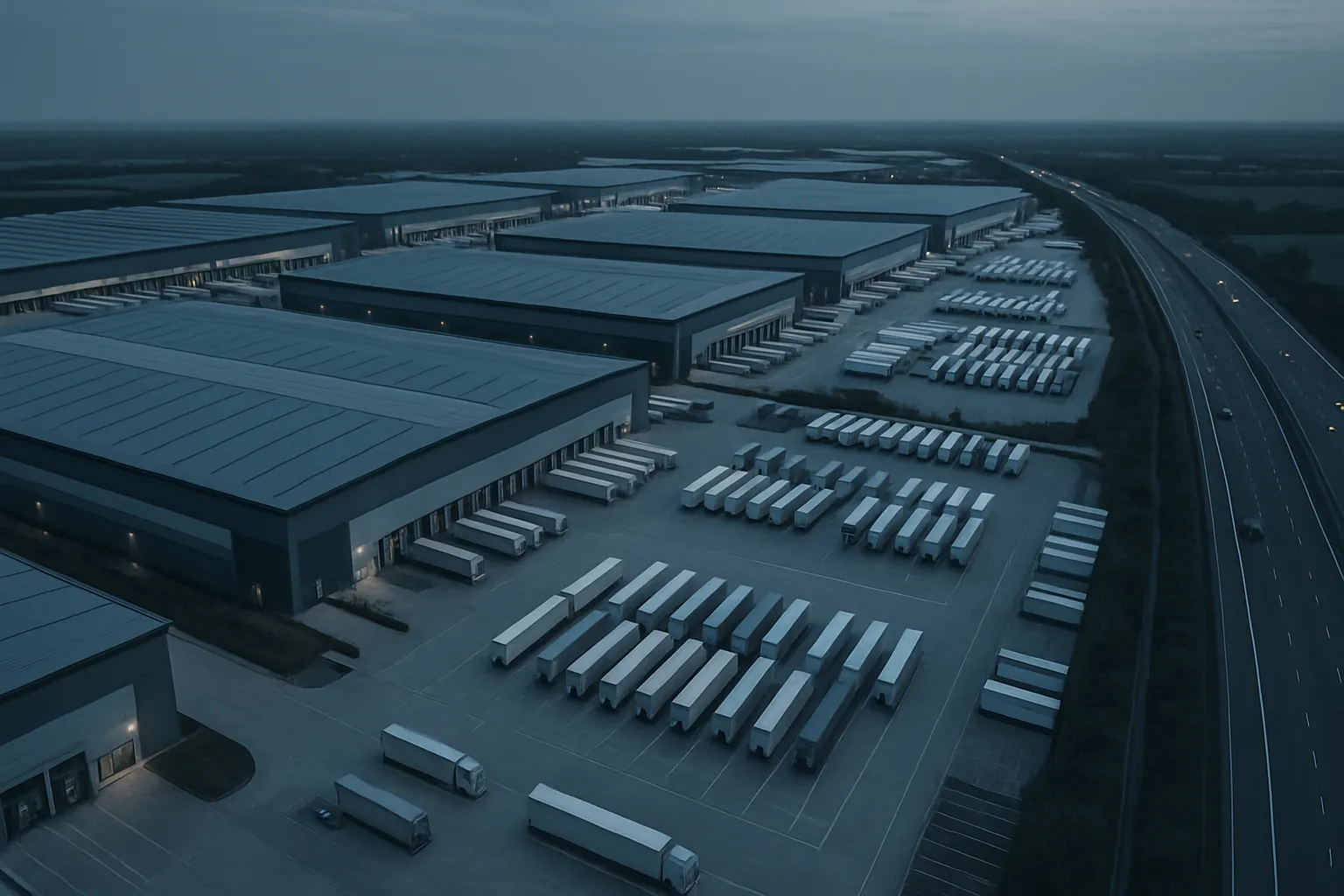
County Durham sits on the A1(M) spine between Tyneside and Teesside, and its industrial market is defined less by speculative big-box estates than by a handful of nationally significant manufacturing and logistics anchors. Aycliffe Business Park, the largest employment site in the county, is built around Hitachi Rail's rolling stock factory at Merchant Park off Junction 59 of the A1(M), which has a rail-connected assembly line feeding train orders into the national network. To the south, Integra 61 has converted a 205-acre site off Junction 61 into a logistics destination anchored by an Amazon fulfilment centre, while Tornado Way and the adjacent Fabric development form a second Amazon-led cluster on the edge of Darlington.
Occupier demand here is a blend of advanced manufacturing and distribution rather than pure logistics. Cummins, Caterpillar, NSK and Mecaplast represent engineering and component supply chains, while Amazon, DHL, FedEx and Aldi cover parcel and grocery distribution. Newton Aycliffe, Darlington, Durham and Peterlee carry most of the floorspace, with Peterlee's South West, North West and North East Industrial Estates and Bishop Auckland's South Church Enterprise Park supplying the older, smaller-unit stock that underpins local engineering and trade demand.
The A1(M) does the heavy lifting. The two junctions that matter most are J59 at Newton Aycliffe, where Aycliffe Business Park and Merchant Park sit, and J61, where Integra 61 has unlocked large-format logistics. These are the locations where land is serviced, planning is supportive and a single occupier can take 200,000 sq ft or more. Darlington adds a third focus around the Amazon-anchored Tornado Way and Fabric sites, again leaning on A1(M) and A66 access toward Teesside and the Pennine routes.
The county also benefits from its inclusion in the Teesside Freeport, which extends customs and tax advantages to qualifying sites in the wider area and reinforces the case for manufacturing-led occupiers locating here. The practical effect is that new floorspace clusters tightly around a few junctions rather than spreading evenly, which keeps prime stock scarce and concentrates value in the Aycliffe and Integra 61 nodes.
Cushman and Wakefield put North East prime industrial rents at roughly 8.00 to 8.50 pounds per sq ft in Q2 2025, with regional availability of about 1.77m sq ft and take-up near 0.39m sq ft. Against a national prime big-box rent of around 11.90 pounds per sq ft, up 5.2 percent year on year (Colliers, June 2025), County Durham trades at a clear discount. That discount is the county's recurring theme: occupational cost is low, but so is the rent that underwrites speculative development.
Thin regional availability tells you that genuinely modern, well-located stock is in short supply. When a build-to-suit such as a Hitachi expansion or an Amazon shed completes, it is typically pre-let, so the open market sees little Grade A space. The result is a two-tier market, with modern A1(M) units commanding the top of the rent range and older estate stock in Peterlee and Bishop Auckland trading well below it.
North East prime industrial yields sit around 5.9 percent (Cushman and Wakefield, Q2 2025), notably softer than the national prime range of roughly 5.00 to 5.25 percent (Knight Frank, December 2025) and a long way from the sub-5 percent pricing seen in the golden triangle. Secondary assets nationally price near 6 percent, and in County Durham much of the older estate stock sits at or beyond that level.
For investors this means capital values per sq ft are modest, which cuts both ways. Entry pricing is accessible and income yields are attractive relative to the South, but the depth of institutional buyer demand is shallower, so exit liquidity depends heavily on covenant quality. An Aycliffe unit let to Hitachi or an Integra 61 box let to Amazon prices very differently from a multi-let trade estate in Peterlee, even where the physical buildings are comparable.
The demand story rests on manufacturing and the supply chains around it. Hitachi Rail's presence has seeded an engineering ecosystem at Aycliffe, and the county's wider occupier base, from Cummins and Caterpillar to NSK, reflects a manufacturing economy rather than a pure consumer-logistics one. That matters for finance because manufacturing leases tend to be long and occupier fit-out heavy, which supports income durability but raises re-letting risk if a plant closes.
Distribution demand from Amazon, DHL, FedEx and Aldi adds the volume logistics layer, drawn by A1(M) access and lower-cost land. The combination gives lenders a reasonably diverse tenant pool, but the concentration of headline value in a small number of large occupiers means covenant analysis carries unusual weight in any County Durham deal.
We arrange and introduce debt across the full lifecycle of industrial assets here, and we approach the county with its discount-to-South pricing in mind. For purchases of let units on the A1(M) corridor, whether a single-let box at Integra 61 or a multi-let estate in Peterlee, we place senior investment loans where pricing keys off lease length and covenant; a long income stream to a Hitachi or an Amazon supports keener terms than a short multi-let income, and we structure debt service cover accordingly.
For transitional situations we use bridging finance, for example to acquire a vacant or part-let estate at Bishop Auckland or Darlington ahead of refurbishment and re-letting, and to bridge a freehold purchase while leases are regeared. Where clients are building, we arrange development funding for serviced plots at Aycliffe Business Park or the Integra 61 and Darlington clusters, sized against pre-lets given the scarcity of speculative comparables and the lower prime rent. Once a scheme is let and stabilised, we refinance onto longer-term investment debt to release development profit and lock in income, and we are mindful that the softer North East yield means lenders will lend against valuations that reflect 5.9 percent pricing rather than golden-triangle metrics. Throughout we act as arranger and introducer rather than lender, matching each asset to the lenders most comfortable with the county's manufacturing-led, discount-priced profile.
With national rental growth forecast at roughly 2.7 to 2.9 percent for 2026 and development completions running at their lowest since 2018, the scarcity of modern stock along the A1(M) should support rents on the best Aycliffe and Integra 61 units. The county's freeport status and its manufacturing anchors give it a structural demand floor, but value remains tightly tied to covenant, and we expect the gap between prime junction-side assets and secondary estate stock in Peterlee and Bishop Auckland to persist.
Market figures are North East-level benchmarks attributed to Cushman & Wakefield (Marketbeat Logistics & Industrial, Q2 2025), used as regional context for County Durham rather than a county-specific measurement. National figures: VOA and the research houses as cited.
Each town carries its own logistics geography and regional market context.
Five products across the whole warehouse lifecycle.
We arrange funding to acquire let warehouse and industrial investment assets across the UK.
We arrange fast, short-term bridging to secure or reposition warehouse and industrial assets.
We arrange funding for ground-up logistics and industrial schemes and major refurbishment.
We arrange funding to carry a newly completed or part-let warehouse through to full occupancy.
We arrange long-term investment mortgages on stabilised, income-producing warehouse assets.
Every sub-type is underwritten differently. We know which lenders back each one.
Send us the outline and we will come back with a view on fundability and likely terms.