5
Logistics locations
A warehouse and logistics market report for Berkshire, with the finance we arrange across 5 logistics locations in the county.
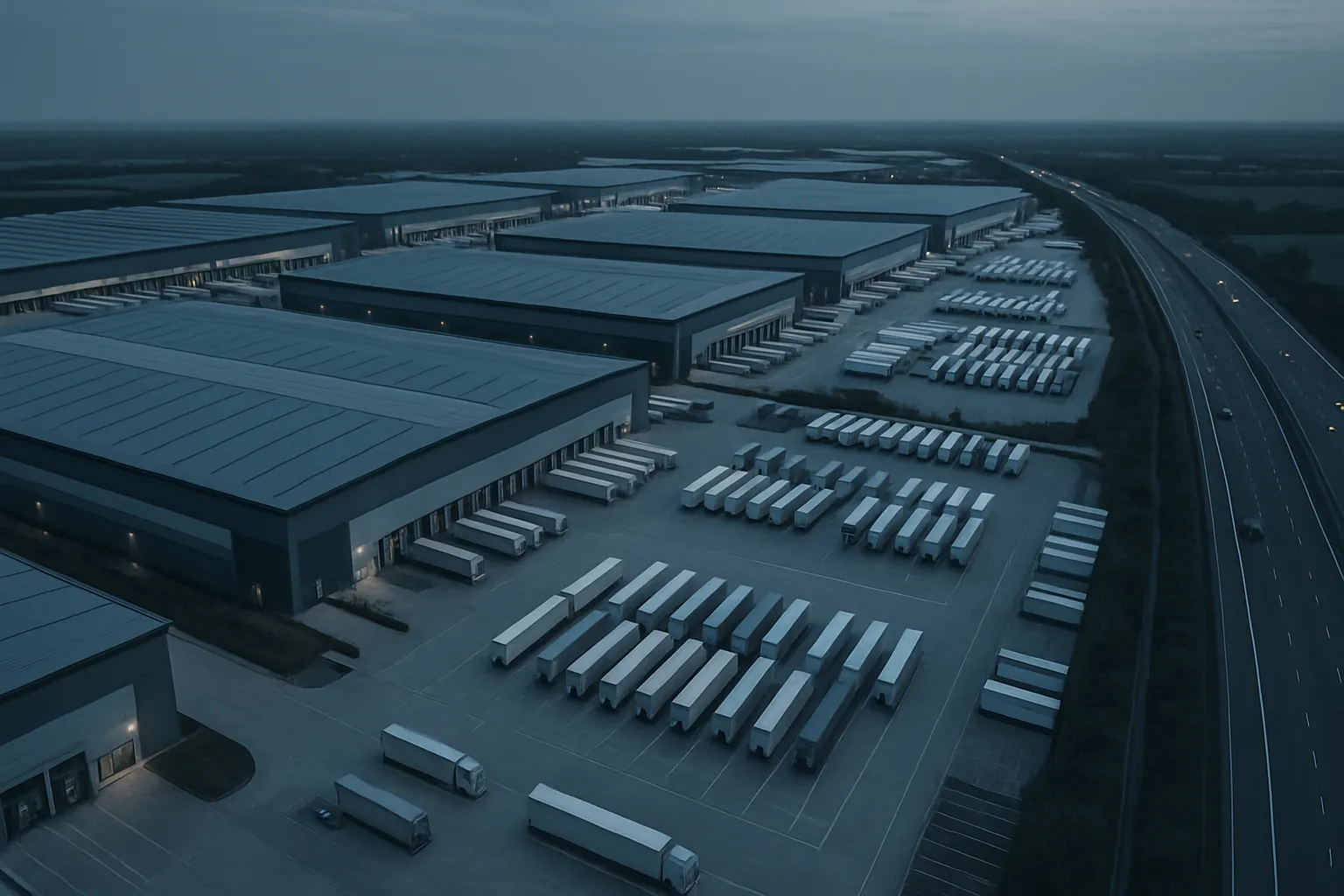
Berkshire is one of the most rent-resilient industrial markets in the South East, and the reason is geography. The county straddles the western M4 corridor, with Slough and Reading anchoring a band of demand that runs from the edge of Greater London out toward the Thames Valley technology cluster. Slough Trading Estate, owned by SEGRO, is the largest single-ownership business park in Europe at around 7.5 million sq ft, and its sheer scale sets the tone for the whole county: occupiers here are paying for proximity to London and the M4 rather than for cheap space.
Demand is broad rather than dominated by pure logistics. Vodafone runs its UK headquarters at Newbury, Waitrose and Mars sit in the county, and manufacturers and distributors such as John Guest, Screwfix, B&Q, ADI Global Distribution and Land Rover share the corridor with parcel operators including DHL. That mix of corporate occupier, trade counter, light manufacturing and last-mile distribution is what keeps Berkshire rents among the highest outside London and underpins the case for industrial as a defensive asset class here.
Industrial activity in Berkshire clusters around a handful of motorway access points. Trade City Reading and Reading Logistics Park sit beside Junction 11 of the M4, while the Norreys Drive site and the planned Reform Road logistics centre lie within a mile of Junctions 8 and 9. Bracknell's principal estate is the Western Industrial Area on Western Road, and Newbury is served by Greenham Business Park and the Hambridge Road estate. Slough sits closest to London and commands the keenest rents.
The practical effect is a market where location within the county matters as much as the county headline. Slough and Reading pull the strongest occupier interest and the lowest yields, while Bracknell, Maidenhead and Newbury trade at a discount that reflects their distance from the M4 spine. For investors and developers, the premium sites are those that combine a junction within a mile and an existing power and labour catchment, both of which are increasingly the binding constraints in the Thames Valley.
Berkshire has very little undeveloped employment land near its motorway junctions, and the Green Belt and Areas of Outstanding Natural Beauty around the county restrict where new sheds can be built. The result is a market that behaves like an inner-London submarket: existing stock is intensively used, refurbishment and redevelopment of older estates is the main route to new space, and large speculative units are rare. The Slough Trading Estate's scale is itself a product of decades of consolidation that cannot easily be repeated elsewhere in the county.
Against that backdrop the regional Cushman & Wakefield read for the South East and East shows prime rents around 23.50 pounds per sq ft, a prime yield near 4.9 percent, take-up of 1.63m sq ft and availability of 12.04m sq ft in Q2 2025. Berkshire sits at the expensive, supply-starved end of that regional picture. Nationally, prime industrial yields have held in the 5.00 to 5.25 percent range through to December 2025 (Knight Frank), so the sub-5 percent regional prime reflects the rarity of well-located Thames Valley assets.
The investment case in Berkshire rests on rental durability rather than yield. With national prime big-box rents around 11.90 pounds per sq ft, up 5.2 percent year on year (Colliers, June 2025), and a 2026 rental-growth forecast of roughly 2.7 to 2.9 percent, Berkshire's premium pricing is justified only if rents keep climbing. The county's structural undersupply and the strength of its occupier base make that more credible here than in most markets.
For asset values the implication is that the safest capital is concentrated in modern, well-specified units near Slough and Reading, where reversionary rental growth supports the keen yield. Secondary stock on older estates, where national secondary yields sit nearer 6 percent, offers higher running income but carries obsolescence and capital-expenditure risk as occupiers increasingly demand power capacity, EV charging and better sustainability ratings.
New supply in Berkshire is overwhelmingly a story of intensification rather than greenfield expansion. The most active opportunities are the redevelopment of tired units on established estates such as the Western Industrial Area and Hambridge Road, and the delivery of planned schemes like the Reform Road logistics centre close to the M4 at Junctions 8 and 9. Power availability around the Thames Valley, where data centre demand competes hard for grid capacity, is now a genuine differentiator between developable and stranded sites.
Newbury and Bracknell offer the clearest run at new floorspace because land is marginally more available away from the M4 spine, but even there the constraint is planning and infrastructure rather than demand. Developers who can assemble a junction-adjacent site with secured power are in a strong position, because the depth of occupier demand means a well-located scheme is unlikely to sit empty for long.
We arrange finance across the full lifecycle of a Berkshire industrial asset, and we work as an introducer to lenders rather than as a lender ourselves. For acquisitions of let estates on the M4 corridor, we place senior investment loans where the keen yield and strong covenant support competitive leverage, and we use the rental durability of Slough and Reading stock to argue for sharper margins than a headline regional number would suggest.
Where speed matters, on an off-market purchase, an auction lot or a unit bought with vacant possession for refurbishment, we arrange bridging that completes quickly and is structured to roll into a term facility once the asset is income-producing. For ground-up and redevelopment schemes, including intensification of older estates and junction-adjacent logistics units, we put together development funding that releases against build milestones and, critically, accounts for the power and infrastructure works that Thames Valley sites so often require.
On completion we refinance from development or bridging facilities onto stabilisation and then long-term investment debt as units let and income proves out. Because Berkshire rents are high and supply is tight, we can usually evidence strong reversionary potential to lenders, which helps on both loan-to-value and pricing. Across purchase, bridging, development, stabilisation and term debt we tailor the structure to the asset's position on the M4 and to the strength of its occupier income.
Berkshire should remain one of the tightest and most expensive industrial markets in the South East. Structural undersupply, a deep and diverse occupier base and competition for power from data centres all point to durable rental growth in line with or ahead of the 2.7 to 2.9 percent national forecast for 2026. The main risk is that the same constraints throttle the new supply that would let investors deploy capital, so the best-positioned owners will be those holding modern, well-powered units near Slough and Reading.
Market figures are South East-level benchmarks attributed to Cushman & Wakefield (Marketbeat Logistics & Industrial, Q2 2025), used as regional context for Berkshire rather than a county-specific measurement. National figures: VOA and the research houses as cited.
Each town carries its own logistics geography and regional market context.
Five products across the whole warehouse lifecycle.
We arrange funding to acquire let warehouse and industrial investment assets across the UK.
We arrange fast, short-term bridging to secure or reposition warehouse and industrial assets.
We arrange funding for ground-up logistics and industrial schemes and major refurbishment.
We arrange funding to carry a newly completed or part-let warehouse through to full occupancy.
We arrange long-term investment mortgages on stabilised, income-producing warehouse assets.
Every sub-type is underwritten differently. We know which lenders back each one.
Send us the outline and we will come back with a view on fundability and likely terms.