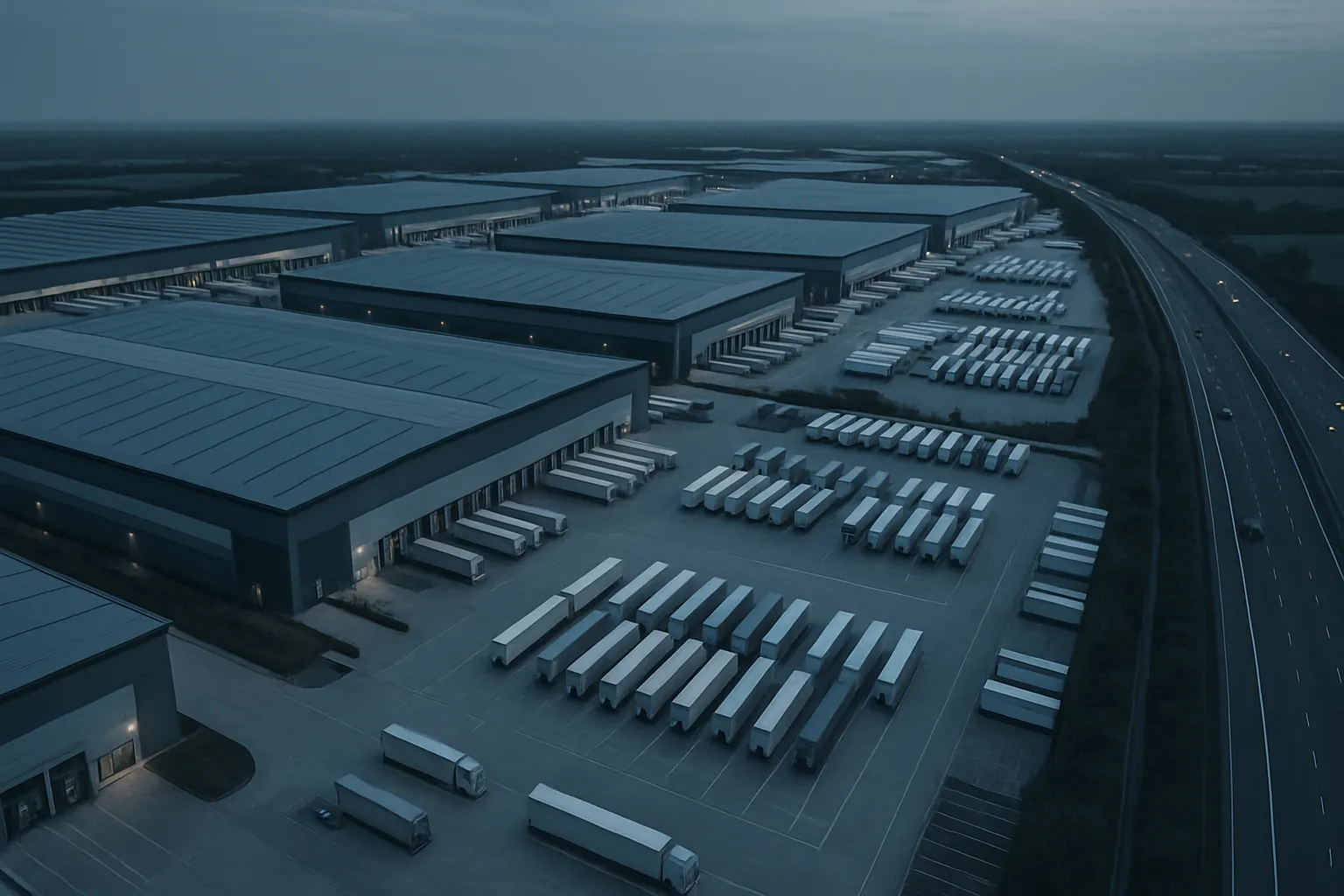
The UK industrial and logistics property market
The UK industrial and logistics market is one of the largest and most closely watched parts of commercial property, spanning everything from small urban industr

The UK industrial and logistics market is one of the largest and most closely watched parts of commercial property, spanning everything from small urban industrial units to the giant big-box distribution warehouses that serve national retailers. It is the physical backbone of online shopping, manufacturing and the supply chain, and it has drawn heavy investment over the past decade as demand for warehouse and logistics space has reshaped how goods move around the country.
This briefing pulls together the headline numbers on size, rents, yields and the regional heartland, and looks ahead to the outlook for 2026. Wherever we cite a figure we attribute it to the agency that published it and note the size threshold used, because take-up totals vary depending on whether the count starts at 50,000 square feet or at 100,000 square feet. As an introducer arranging finance against these assets, we track the logistics market closely, since the rent, the lease and the valuation behind a building drive what a lender will lend.
How big is the UK logistics market?
The UK logistics market is measured most often by annual take-up, the volume of space let or sold to occupiers in a year. On a 50,000 square feet and above basis, take-up reached around 40.8 million square feet in 2025 according to Knight Frank, a solid year by historic standards. Measured only on big-box units of 100,000 square feet and above, Savills recorded roughly 33 million square feet over the same period, the gap between the two figures reflecting the different size thresholds rather than any disagreement about the market.
Behind those totals sits a deep stock of existing buildings and a steady churn of new requirements from retailers, manufacturers and third-party logistics operators, the 3PL firms that run distribution on behalf of others. The logistics market is large enough that even a quieter year still moves tens of millions of square feet, which is why the sector has become a core holding for institutional investment and a reliable category for lenders financing the buildings.
What are prime rents and yields doing?
Prime rents have kept rising even as take-up has normalised. Colliers put the prime big-box rent at around £11.90 per square foot as of June 2025, up 5.2 percent year on year, a healthy increase that reflects how little of the best new space is available. Rising rents support rental income on existing buildings and feed through into the valuation, which is good news for investors holding well-let logistics assets.
On the investment side, the prime industrial yield has settled. Knight Frank reported the prime yield at around 5.00 to 5.25 percent and stable as of December 2025, a sign that pricing has steadied after the sharp repricing of recent years. A stable yield alongside a rising rent is a constructive backdrop, because it means values are being supported by income growth rather than by yield compression, which is generally a more durable basis for investment performance.
For anyone financing a purchase, the combination matters. A keen yield and a growing rent give a lender confidence in the valuation, and a confident valuation supports the loan, so the market's fundamentals flow straight through to the terms available on a deal.
What is the Golden Triangle and why does location matter?
The Golden Triangle is the logistics heartland of the English Midlands, the area roughly bounded by the M1, M6 and M42 motorways where a distribution warehouse can reach a large share of the UK population within a few hours' drive. Occupiers prize it because it minimises transport cost and delivery time, and that demand has made it the most sought-after logistics location in the country, with rents and land values to match.
Location drives the whole logistics market because the sector is, at its core, about moving goods efficiently. Proximity to motorways, ports and large populations determines how useful a building is to an occupier, and that usefulness sets the rent a landlord can charge. A unit in a prime corridor commands a long lease and a strong rent, while an isolated building struggles to let, which is why investors and lenders weigh location heavily when judging an asset and its valuation.
Who is taking the space and is the sector still growing?
Occupier demand has broadened beyond the online retailers that drove the last surge. Manufacturing was the largest occupier type in 2025, accounting for around 33 percent of take-up according to Savills, a notable shift that reflects firms reshoring production and building resilience into their supply chains. Third-party logistics operators and retailers remain major takers of space alongside them.
On the question of growth, the sector is still expanding but at a steadier pace than the frantic pandemic years. Structural drivers remain firmly in place: online retail keeps growing its share, supply chains continue to favour holding more stock closer to customers, and manufacturing activity is adding fresh demand. Vacancy has risen to around 7.5 percent, above the roughly 4.6 percent ten-year average, which has handed occupiers a little more choice on lease terms and tempered the rampant rental growth of a few years ago without derailing the long-term trend.
The picture is therefore one of a maturing market rather than a stalling one. Demand is real and diverse, supply has loosened from extreme tightness, and the fundamentals that made logistics attractive for investment over the past decade are still intact.
Why has new development slowed?
New supply has pulled back sharply. Development completions reached around 16 million square feet in 2025, the lowest level since 2018 according to Knight Frank, as higher construction costs and a more cautious funding climate held back speculative building. Developers have been reluctant to start schemes without a tenant lined up, so the flow of brand-new space has thinned.
That slowdown has a clear consequence for the years ahead. With completions low and demand steady, the supply of the best new buildings stays tight, which underpins prime rents and supports the rental income on existing well-located stock. For investors, scarce new supply is a tailwind for values; for occupiers needing modern space, it means competition for the limited number of quality units coming through, and a willingness to commit to a longer lease to secure them.
What is the outlook for industrial and logistics in 2026?
The outlook for 2026 is cautiously positive. With a stable prime yield, rising prime rents, broadening occupier demand and constrained new supply, the ingredients are in place for steady performance rather than a boom or a bust. Modest rental growth looks set to continue on the best buildings, while the slightly higher vacancy rate keeps the market balanced and gives occupiers room to negotiate a lease without undermining values.
The main variables to watch are the cost of debt and the pace of new development. If funding conditions ease, more speculative schemes may start, which would gradually add supply and cool rental growth on the best stock. If construction stays subdued, the supply squeeze persists and prime rents push on. Either way the structural case for logistics, rooted in online retail, reshoring manufacturing and resilient supply chains, remains intact, which is why the sector continues to attract investment and to support lending against well-let warehouse and distribution assets.
The UK industrial and logistics property market: common questions
How big is the logistics market in the UK?
Measured by annual take-up, the UK logistics market reached around 40.8 million square feet in 2025 on a 50,000 square feet and above basis, according to Knight Frank. On a big-box basis of 100,000 square feet and above, Savills recorded roughly 33 million square feet, the difference reflecting the size threshold each agency uses rather than a disagreement about activity.
What is the industrial and logistics outlook for 2026?
The outlook for 2026 is cautiously positive, with a stable prime industrial yield of around 5.00 to 5.25 percent reported by Knight Frank in December 2025, rising prime rents and constrained new supply. Steady rather than spectacular growth is the likely path, supported by manufacturing demand and online retail, with the cost of debt and the pace of development the main factors to watch.
How big is the UK 3PL market?
Third-party logistics operators, the firms that run distribution and warehousing on behalf of others, are one of the largest groups taking space in the UK logistics market, alongside manufacturers and retailers. They account for a substantial share of annual take-up, and their requirements scale with retail and supply chain activity, making them a key source of demand for big-box distribution buildings.
Is logistics a growing sector?
Yes, though at a steadier pace than during the pandemic peak. Online retail continues to expand its share, supply chains favour holding more stock closer to customers, and manufacturing was the largest occupier type in 2025 at around 33 percent of take-up according to Savills. Vacancy has eased to roughly 7.5 percent, giving occupiers more choice, but the structural drivers behind the sector's growth remain firmly in place.
Ready to talk about a real deal?
Send us the warehouse and we will come back with a view on fundability and likely terms within one working day.