Open storage and IOS as an asset class
Industrial outdoor storage, usually shortened to IOS, is open, surfaced land let for storage, parking and the staging of goods and vehicles. It is the simplest

Industrial outdoor storage, usually shortened to IOS, is open, surfaced land let for storage, parking and the staging of goods and vehicles. It is the simplest asset in the industrial property family, often little more than a secure, hard-surfaced yard, yet it has become one of the most talked-about investment niches in the market. We arrange and introduce property finance rather than lend ourselves, and IOS comes up increasingly often because investors are drawn to its low capital intensity and its role in the wider logistics and distribution chain.
This guide explains what industrial outdoor storage is, why it attracts investor interest, who uses it and how lenders approach funding it. We have written it for investors weighing an IOS purchase and for operators who occupy yards and want to understand the market they sit in. Because IOS is an emerging segment, there is no standalone published rent or yield series for it in the way there is for big-box logistics, so we keep those figures qualitative and concentrate on the considerations that actually shape a deal.
What is industrial outdoor storage and IOS investment?
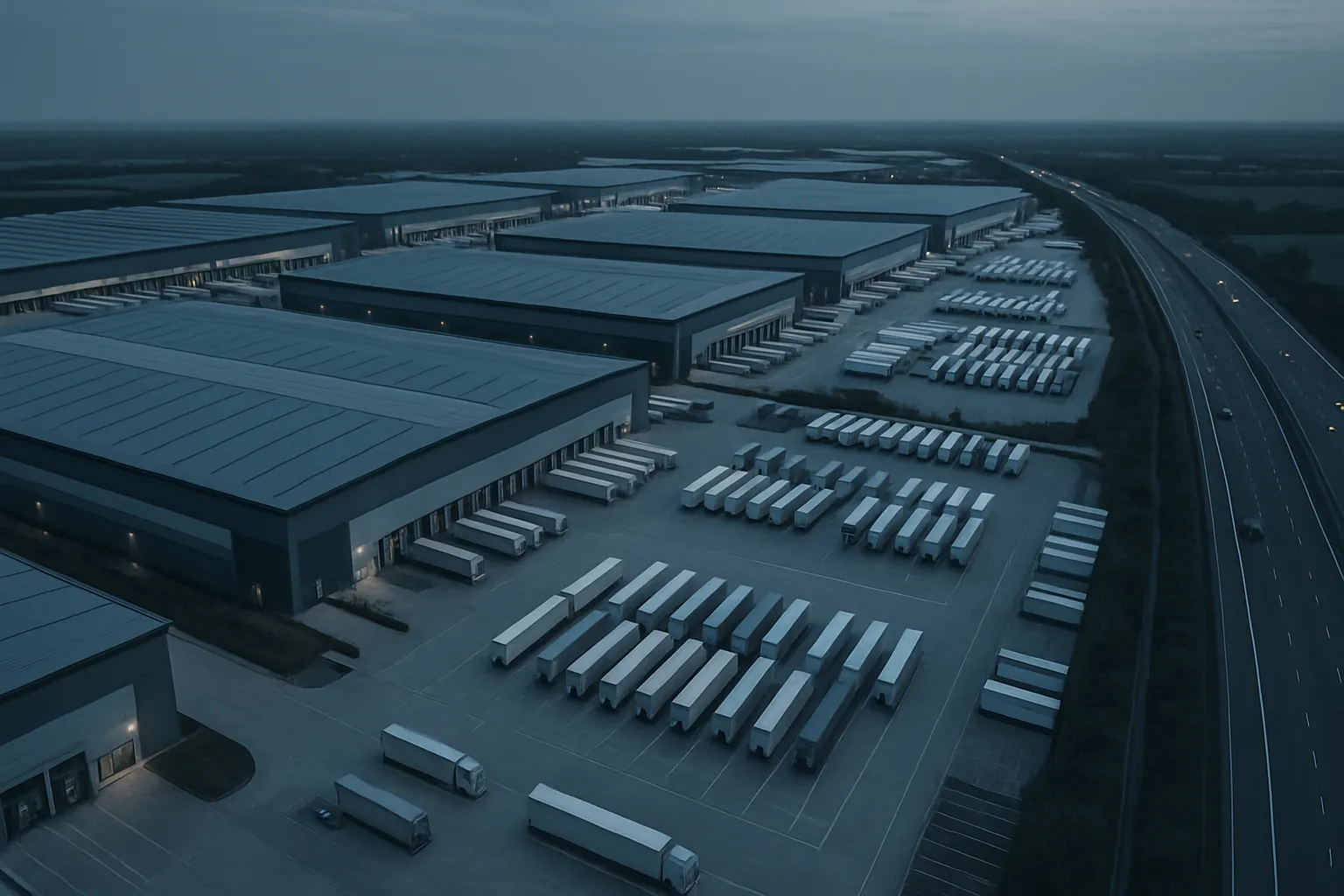
Industrial outdoor storage is open, surfaced land let for storage and parking rather than for buildings. A typical IOS site is a secure, fenced, hard-surfaced yard, sometimes with a small office or modest unit attached, used to hold goods, containers, plant, vehicles or building materials in the open air. The defining feature is that the value sits in the land and the surface, not in a warehouse. That simplicity is precisely what makes IOS distinctive, because the asset needs little construction and the income comes from letting space rather than floorspace.
Savills, which has published research describing the emergence of industrial outdoor storage in Europe, frames it as a sector driven by the same forces as mainstream logistics but serving needs that a sealed warehouse cannot. Vehicles, containers, plant and bulky materials often have to sit outdoors near transport links, and well-located yards are scarce because so much former open land has been built on or lost to other uses. That scarcity, set against steady demand, is the core of the IOS investment case.
For an investor, IOS sits at the low-capital, low-management end of the industrial spectrum. There is no building to maintain, no plant to replace and relatively little to go wrong with a surfaced yard, which keeps running costs and capital expenditure modest. The flip side is that income per acre is lower than for a built warehouse, and value rests heavily on the planning status of the land and its location relative to transport. The appeal is a clean, simple income stream from a scarce and useful type of land.
Why are investors interested in IOS?
Investors are drawn to industrial outdoor storage because it offers logistics-adjacent income with very low capital intensity. There is no expensive shell to build or refurbish, so the entry cost per site can be modest and the ongoing capital demands are light. In a market where prime industrial yields held broadly stable at around 5.00 to 5.25 percent according to Knight Frank in December 2025 and well-located stock is scarce, IOS gives investors a way to gain industrial exposure without the construction cost and management burden of a warehouse.
Scarcity underpins the rental story. Suitable open yards near motorways, ports and urban centres are hard to find, because the land is valuable for other uses and planning consent for open storage is not always easy to obtain. That scarcity supports rents and makes existing, consented yards genuinely useful to occupiers who have nowhere else to put their vehicles, containers or materials. Demand comes from logistics, construction, plant hire, vehicle storage and similar trades that need outdoor space close to where they operate.
Because IOS is an emerging asset class, there is no established published rent or yield benchmark specific to it, and we treat any return figures qualitatively rather than quoting a precise series. That lack of a benchmark is itself part of the opportunity, because pricing is less efficient than in mainstream logistics and a well-judged purchase can be bought on attractive terms. It also means an investor needs to do more of their own work on rent evidence and planning, which is exactly where careful due diligence and the right finance structure matter most.
How do lenders approach financing open storage land?
Lenders approach industrial outdoor storage cautiously, because it is land-based and emerging rather than a familiar built asset. The security is the value of the land and its surface, which depends heavily on planning status and location, so a lender pays close attention to whether the open storage use is properly consented and lawful. A yard with secure, established planning for storage is far more fundable than one operating on an uncertain or temporary basis, because the lender needs confidence that the income-producing use can continue.
Income and lease terms also shape the lending decision. Because IOS often lets on shorter or more flexible terms than a warehouse, a lender examines the tenant base, the rent and the durability of the income before sizing the loan. The absence of a published yield benchmark means a lender relies more on the specific evidence in front of it, and on its own view of the land's underlying value, which can make loan to value more conservative than for a let warehouse with a long lease and a strong covenant.
This is where our role is most useful. Not every lender understands or has appetite for open storage, so placing an IOS case with a generalist funder often ends in a decline. We identify the lenders genuinely comfortable with land-based and emerging industrial assets, and we present the planning position, the income and the location in the way those lenders want to see it. Because we arrange and introduce rather than lend, our incentive is simply to find the funding that fits this particular and still-evolving type of investment.
What should you check before buying an IOS site?
Planning status is the first thing to confirm, because it underpins everything else. An open storage use needs lawful planning consent, and a yard operating without it, or on a temporary or uncertain basis, carries a risk that the income could be challenged or curtailed. Before committing, an investor should establish exactly what use is permitted, whether any conditions limit hours, vehicle movements or the type of goods stored, and how secure that consent is. A site with clear, established planning for storage is far more valuable and far more fundable than one where the use is in doubt.
Location and the surface come next. The value of an IOS site rests on its proximity to motorways, ports or urban centres and on the quality of the hard standing, drainage and security, because occupiers pay for a yard that is genuinely usable rather than simply available. A well-surfaced, well-drained, secure site near transport links commands a stronger rent and lets more readily than a rough plot in a poor location. An investor should look closely at the condition of the surface and any remediation it might need, since that cost bears directly on the return.
Finally, weigh the income and the exit. Because there is no standalone published rent or yield series for IOS, an investor has to build their own view of the rent from local evidence and comparable yards rather than leaning on a market benchmark. It is also worth thinking about the eventual exit: a consented, well-located yard may have value not only as open storage but as potential development land in the longer term, which can add to the upside. We help investors test all of this and structure the finance around it, so the purchase rests on evidence rather than on the optimism that an emerging sector can encourage.
Open storage / IOS: common questions
What is industrial outdoor storage?
Industrial outdoor storage, or IOS, is open, surfaced land let for storage and parking rather than for buildings. A typical site is a secure, fenced, hard-surfaced yard, sometimes with a small office attached, used to hold goods, containers, plant, vehicles or materials outdoors. The value sits in the land and the surface rather than in a warehouse, which makes IOS the simplest and least capital-intensive asset in the industrial property family.
Is industrial outdoor storage a good investment?
IOS can be an attractive investment because it offers logistics-adjacent income with very low capital intensity, no building to maintain and modest running costs, while suitable consented yards near transport links are genuinely scarce. The trade-offs are that income per acre is lower than for a built warehouse, value depends heavily on planning status, and there is no established published rent or yield benchmark, so it requires careful due diligence and a lender comfortable with land-based assets.
Why are investors interested in IOS?
Investors are drawn to industrial outdoor storage because it gives industrial exposure without the cost of building or maintaining a warehouse, and because well-located yards are scarce, which supports rents. Demand comes from logistics, construction, plant hire and vehicle storage trades that need outdoor space near where they operate. With prime industrial yields broadly stable at around 5.00 to 5.25 percent according to Knight Frank in December 2025, IOS offers a low-capital route into the sector.
How do lenders finance industrial outdoor storage?
Lenders approach IOS cautiously because it is land-based and emerging rather than a familiar built asset. They focus heavily on planning status, since the open storage use must be properly consented for the income to be secure, and on the durability of the rent and the location. The lack of a published yield benchmark means lenders rely on the specific evidence in front of them, often resulting in more conservative loan to value. Matching the deal to a lender comfortable with land-based industrial assets is key.
Ready to talk about a real deal?
Send us the warehouse and we will come back with a view on fundability and likely terms within one working day.