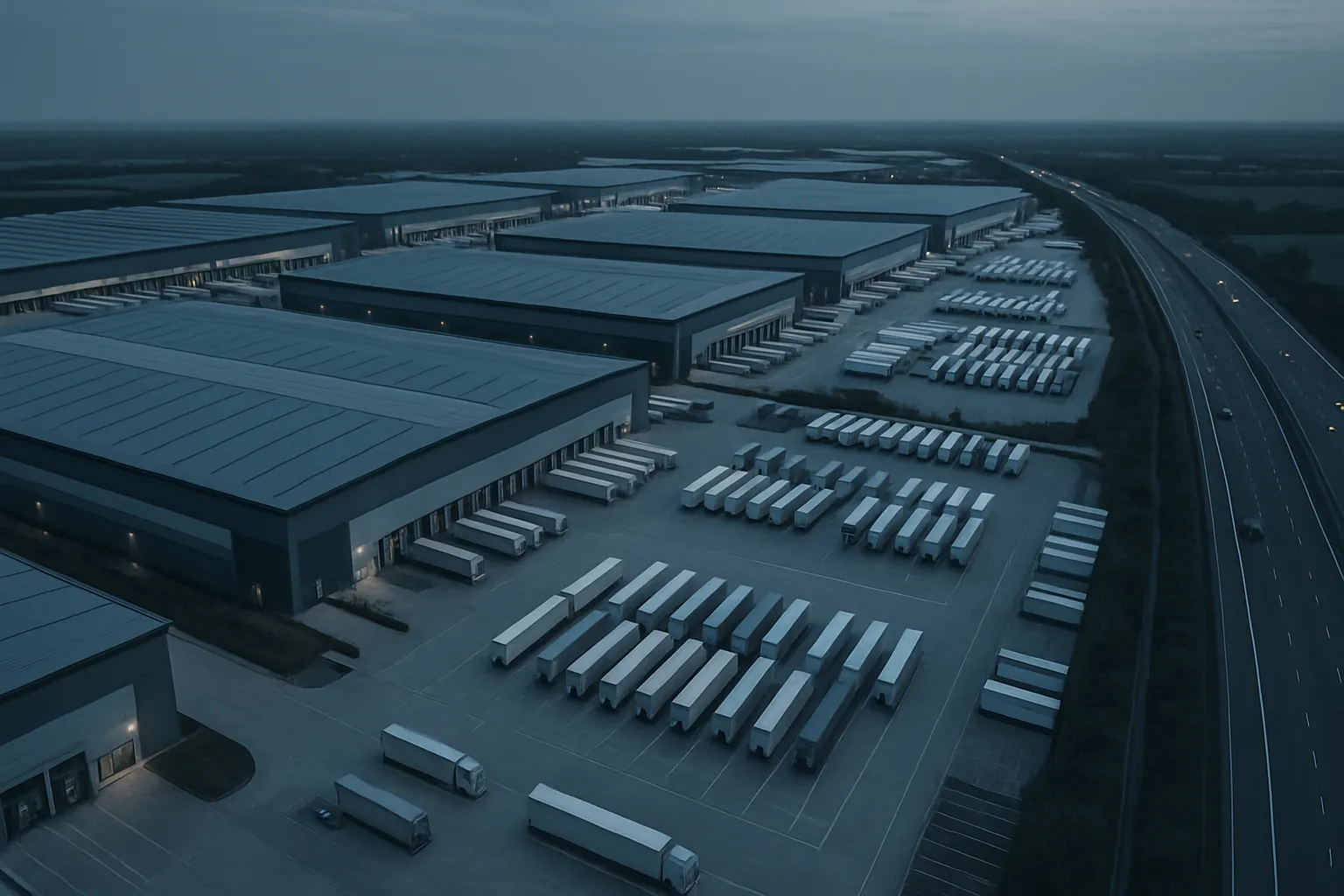
The Golden Triangle of UK logistics
The Golden Triangle is the logistics heartland of the English Midlands, the area where a warehouse can reach the largest share of the UK population inside a sin

The Golden Triangle is the logistics heartland of the English Midlands, the area where a warehouse can reach the largest share of the UK population inside a single four and a half hour drive. It is loosely bounded by the motorway towns of Northampton, Leicester and the area around the M1, M6 and M42, and it has become shorthand among occupiers, investors and developers for the most sought-after logistics location in the country. We arrange and introduce property finance rather than lend ourselves, so we spend a great deal of time looking at where warehouse and distribution demand is concentrated, and the Golden Triangle is where that demand is most intense.
This guide explains what the Golden Triangle is, why it matters for logistics, which occupiers cluster there and how the wider distribution market sits around it. We have written it for anyone weighing a warehouse purchase, a logistics development or an industrial investment in the Midlands, and for owner-occupiers trying to understand why rents and land values in this corridor sit above the regional average. Throughout we point to real market figures so you can see how the theory of the Golden Triangle translates into rent, take-up and yield on the ground.
What is the Golden Triangle in UK logistics?
The Golden Triangle is a roughly triangular zone in the East and West Midlands, traditionally drawn between junctions on the M1, M6 and M42 around Northampton, Leicester, Tamworth and Lutterworth. Its defining feature is reach. A distribution warehouse placed inside this triangle can serve around ninety percent of the UK population within a four hour heavy goods vehicle drive, which is why national retailers and logistics operators concentrate their largest distribution centres here. The label is informal, but the geography behind it is precise, and it rests on the motorway network rather than on any single town.
The Office for National Statistics has examined this clustering and confirmed that transport and storage activity, and warehouse floorspace in particular, has grown fastest in parts of the Midlands, the East of England and Yorkshire and the Humber. The rise of online retail accelerated the trend, because e-commerce fulfilment needs large, modern sheds positioned to reach customers quickly. The Golden Triangle offered land, motorway access and labour in the right place, so the big-box logistics market gravitated toward it.
It helps to separate the term from its imitations. The phrase Golden Triangle is also used for a tourist circuit in India and for clusters in other sectors, but in UK property it means this Midlands logistics corridor and nothing else. When an agent or developer talks about a shed in the Golden Triangle, they are signalling that the building sits in the prime national distribution location, with the rent, land value and competition for space that come with that status.
The boundaries are deliberately loose rather than fixed, which is one reason the term causes confusion. Some draw the triangle tightly around the M1, M6 and M42 junctions, while others stretch it to take in the wider East Midlands, parts of the West Midlands and the corridor up toward Yorkshire and the Humber where warehouse floorspace has also grown rapidly. What unites every version is the drive-time logic: the area is defined by how far a lorry can reach in a working shift, not by any administrative line. As the national road network and the pattern of demand evolve, so does the practical edge of the corridor.
Why has logistics concentrated in the Midlands corridor?
Logistics concentrates where transport cost falls fastest, and the Midlands corridor sits at the centre of the national motorway network. A warehouse near the M1 and M6 interchange can dispatch lorries north, south, east and west without crossing congested urban areas, which keeps delivery times short and fuel cost predictable. For a national distribution operation, shaving even a few minutes off the average drive to customers across thousands of journeys a year is worth a premium on rent, and that premium is exactly what the Golden Triangle commands.
Labour and land reinforce the pull. The corridor has a deep pool of warehouse and driving labour built up over decades, and historically it offered larger development sites than the congested South East. That combination let developers build the very large units, often several hundred thousand square feet, that big-box logistics requires. Once a few anchor occupiers committed, suppliers, hauliers and third-party logistics firms followed to be near them, and the cluster reinforced itself. Distribution begets distribution, and the Golden Triangle became self-sustaining.
The market data shows how tight this corridor has become. Prime big-box logistics rent reached around £11.90 per square foot in mid 2025, up 5.2 percent year on year according to Colliers, and the Midlands sits at the sharp end of that rental growth because supply of large, well-located sites is scarce. Development completions across the UK fell to roughly 16 million square feet in 2025, the lowest since 2018 according to Knight Frank, which means new Golden Triangle stock is in short supply and existing buildings hold their value well.
It is worth understanding why the supply side is so constrained, because it explains the durability of the corridor's premium. Large, flat, well-connected sites near the motorway interchanges are finite, and competing land uses, planning constraints and the time it takes to bring a major scheme forward all limit how quickly new space can arrive. When higher build and finance costs slowed speculative development across the country, the effect was felt acutely in the Golden Triangle, where demand for large units is strongest. The result is a corridor where the best stock is rarely available and where occupiers compete hard for what does come to the market.
That scarcity is what turns the drive-time advantage into a financial one. Because a Golden Triangle warehouse is both highly useful to occupiers and hard to replace, its rent and value are underpinned in a way that stock in looser markets is not. For an owner-occupier, that means buying into a location that should hold its worth; for an investor, it means an asset whose income and capital value rest on genuine, structural demand rather than on a passing cycle. The figures simply confirm what the geography already implies.
Who are the biggest logistics occupiers in the Golden Triangle?
The Golden Triangle is home to national distribution centres for many of the largest names in UK retail and logistics, though no single company dominates the whole corridor. Major grocers, general retailers, parcel carriers and third-party logistics providers all hold space here, alongside e-commerce fulfilment operations that need to reach the whole country quickly. Asking which is the biggest logistics company in the UK is less useful than understanding the mix, because the corridor works precisely because so many different occupiers cluster together and share the labour and transport infrastructure.
The occupier base has shifted in recent years. Manufacturing became the largest single occupier type of UK industrial and logistics space in 2025 at around 33 percent of take-up according to Savills, reflecting reshoring and a desire to hold more stock onshore. Retail and wholesale, parcel and third-party logistics, and pure online fulfilment make up much of the rest. In the Golden Triangle specifically, the largest sheds tend to go to national distribution and fulfilment users who need the four hour national reach the corridor uniquely provides.
This breadth of demand is itself a source of resilience. Because the corridor serves manufacturing, retail distribution, parcel networks and online fulfilment all at once, a slowdown in any one of those activities does not leave the market dependent on a single source of occupiers. When e-commerce growth cooled after its pandemic surge, manufacturing and reshoring demand helped take up the slack, and that diversity of demand is part of why Golden Triangle rents have stayed firm. For an investor, a location whose tenants are drawn from several different parts of the economy is inherently steadier than one reliant on a single trade.
For an investor or owner-occupier, the lesson is about tenant strength rather than tenant identity. A modern Golden Triangle warehouse let to a strong covenant on a long lease is one of the most fundable assets in the UK property market, which is why lenders are comfortable advancing against it. We see this in practice when we arrange finance: a well-located shed with a reliable tenant and a long lease attracts keener terms than an older unit in a weaker location, and the Golden Triangle postcode is part of what makes the covenant story convincing.
How does Golden Triangle demand affect rent and investment value?
Scarce supply and persistent demand push rent and capital value up, and the Golden Triangle shows this clearly. Prime industrial yields across the UK held broadly stable at around 5.00 to 5.25 percent according to Knight Frank in December 2025, with secondary stock closer to 6 percent, and the keenest yields apply to exactly the kind of modern, well-let logistics building the corridor specialises in. A low yield reflects investor confidence, because investors accept a lower income return when they expect rent and value to keep rising. The Golden Triangle attracts that confidence.
Take-up underlines the depth of demand. UK logistics take-up reached around 40.8 million square feet in 2025 on a 50,000 square foot and above basis according to Knight Frank, with the big-box segment of 100,000 square feet and above at roughly 33 million square feet according to Savills. Vacancy sat at about 7.5 percent against a 10 year average near 4.6 percent, so there is more choice than there was at the peak, but prime Golden Triangle stock remains tightly held and rarely sits empty for long.
The national vacancy figure is, in fact, slightly misleading when read against the corridor. Much of the available space sits in secondary buildings or weaker regional locations, while modern, well-specified sheds in the Golden Triangle continue to let quickly. This divergence between prime and secondary is one of the defining features of the current market, and it is most pronounced in the corridor, where the gap between a sought-after new unit and an older, poorly located one is at its widest. An investor reading the headline vacancy rate should therefore look through it to the quality and location of the specific asset.
For finance, this matters because lenders price what they can re-let. A warehouse in the Golden Triangle is easy to value and easy to re-let if a tenant leaves, so a lender views it as lower risk and is willing to fund it at a sensible loan to value. We arrange that funding by matching the building, the lease and the borrower to a lender whose appetite fits, and the strength of the location does a lot of the heavy lifting in that conversation. The corridor's reputation is, in effect, part of the security.
There is also a clustering benefit for occupiers that feeds back into investment value. A distribution operator in the Golden Triangle sits close to its suppliers, its hauliers and the deep pool of warehouse labour the corridor has built up over decades, which lowers its operating cost and makes it more likely to renew its lease rather than relocate. That stickiness is valuable to a landlord and to a lender, because a tenant that is well placed and reluctant to move is a tenant that keeps paying rent. The agglomeration that drew occupiers to the corridor in the first place is the same force that keeps them there once they arrive.
What does the Golden Triangle mean for buyers and developers today?
For a buyer or developer, the Golden Triangle is both an opportunity and a cost. The opportunity is durable demand: a building here is unusually liquid, holds its value and attracts strong tenants, which supports both rental income and resale. The cost is the entry price, because land and rent sit above the regional average and competition for sites is fierce. Anyone funding a purchase or a development in the corridor should expect to pay a premium and should weigh that against the lower letting and re-letting risk the location provides.
The 2026 outlook supports a measured optimism. Rental growth across UK logistics is forecast at around 2.7 to 2.9 percent for 2026, slower than the double-digit surges of the early 2020s but still positive, and the low development pipeline means well-located stock should stay scarce. The Golden Triangle, as the prime national location, is likely to capture more than its share of that growth. For developers, the challenge is finding deliverable sites; for buyers, the challenge is funding a premium asset on terms that still leave the numbers working.
Our role is to make the finance fit the ambition. Whether you are an owner-occupier buying a distribution unit to run your own operation from, or an investor adding a let warehouse to a portfolio, we read the deal, test the rent and value against lender appetite, and place the case where it is most likely to complete on sensible terms. Because we arrange and introduce rather than lend, we can be candid about whether a Golden Triangle purchase stacks up or whether a building in a slightly cheaper corridor would serve you just as well.
How do you finance a warehouse in the Golden Triangle?
Funding a Golden Triangle warehouse follows the same broad path as any commercial property purchase, but the location works in the borrower's favour. Because the corridor is the prime national distribution location, a lender views a sound shed here as easy to value and easy to re-let, which is precisely the comfort a lender needs to advance at a sensible loan to value. The strength of the location feeds directly into the security, so a well-let warehouse in the Golden Triangle tends to attract keener terms than an equivalent building in a weaker corridor with thinner occupier demand.
For an owner-occupier, a lender focuses on the trading business behind the purchase, testing that the operation can comfortably afford the repayments and that owning the distribution unit makes sense against renting it. For an investor, the lender focuses on the rental income and the lease, checking that the rent covers the mortgage payment with a margin and that the tenant is a reliable covenant. In both cases the Golden Triangle postcode helps the story, because the corridor's reputation for durable demand reassures the lender that the income and the value will hold.
Land values and rent in the corridor sit above the regional average, so the deposit and the total cash requirement are correspondingly higher, and we always model the full picture before a client commits. Prime big-box rent of around £11.90 per square foot in mid 2025, up 5.2 percent year on year according to Colliers, signals strong income but also a premium entry price, and an investor needs the rent and the loan to value to align for the numbers to work. We test that alignment early so a deal does not stall once fees, valuation and stamp duty are added.
The choice of lender matters as much as the location. Not every funder is equally comfortable with very large single-let distribution boxes, and appetite shifts as conditions change, so placing a Golden Triangle case with the wrong lender can mean a decline even on a strong asset. We read which lenders are actively funding logistics stock at a sensible loan to value, which have paused and which move quickly, and we place the case once with the funder most likely to complete it. That is how the corridor's underlying strength is turned into finance that actually lands.
The Golden Triangle: common questions
What is the Golden Triangle in logistics?
The Golden Triangle is the prime UK logistics location, a roughly triangular area in the East and West Midlands bounded by motorway junctions on the M1, M6 and M42 around Northampton, Leicester and Tamworth. Its appeal is reach: a distribution warehouse sited inside the triangle can serve around ninety percent of the UK population within a four hour heavy goods vehicle drive, which is why national retailers, e-commerce fulfilment operations and logistics providers concentrate their largest sheds there.
What is the Golden Triangle in UK logistics specifically?
In UK property the Golden Triangle means the Midlands logistics corridor and nothing else, distinct from tourist circuits or clusters elsewhere that share the name. It rests on the national motorway network rather than on any single town, and the Office for National Statistics has confirmed that warehouse floorspace and transport and storage activity have grown fastest in this part of the Midlands, the East of England and Yorkshire and the Humber, driven largely by the growth of online retail.
Who is the biggest logistics company in the UK?
No single company dominates the Golden Triangle or UK logistics as a whole. Major grocers, general retailers, parcel carriers, third-party logistics providers and online fulfilment operators all hold large distribution space in the corridor. More telling than any one name is the occupier mix: manufacturing became the largest single occupier type of UK industrial and logistics space in 2025 at around 33 percent of take-up according to Savills, ahead of retail, wholesale and pure e-commerce.
What is a Golden logistics company?
There is no single firm called the Golden logistics company; the phrase usually refers to operators based in or serving the Golden Triangle logistics corridor. The term Golden Triangle describes the location, not a business. Any well-run distribution operator with a national reach is likely to hold space in the corridor, because the four hour drive-time coverage it offers is hard to match anywhere else in the country.
Ready to talk about a real deal?
Send us the warehouse and we will come back with a view on fundability and likely terms within one working day.